



Brain Tumour Warning Signs: Symptoms That Need Medical Evaluation

Quick answerMost headaches, dizziness and forgetfulness are not caused by a brain tumour. What matters is the pattern. A new or steadily changing neurological symptom in an adult, especially a first-time seizure, progressive weakness on one side, a worsening headache pattern with vomiting or drowsiness, or a persistent change in behaviour or personality, deserves clinical review with an examination and, if indicated, imaging.

Show More
What symptoms can a brain tumour cause?

A brain tumour causes symptoms mainly in two ways. It may irritate or compress the part of the brain where it is growing, producing a focal problem such as weakness, speech difficulty or a visual change. It may also increase pressure inside the skull, particularly if it is large, grows quickly or interferes with normal cerebrospinal fluid pathways. The exact symptom therefore depends more on location and behaviour than on the label “brain tumour” alone.

Some tumours are found incidentally on a scan done for an unrelated reason. Others announce themselves through seizures, progressive weakness, personality or cognitive change, or a headache pattern that is clearly different from the patient’s usual headaches. One isolated symptom rarely proves the diagnosis.

Symptoms that should not be ignored

  • New-onset seizure in an adult, particularly when there is no previous history of epilepsy.
  • Progressive weakness, clumsiness or numbness affecting one side of the body.
  • New difficulty with speech, understanding words, reading or finding the right words.
  • Persistent visual disturbance such as double vision, loss of part of the visual field or steadily worsening vision.
  • A new headache pattern that becomes more frequent, more intense or is accompanied by vomiting or neurological symptoms.
  • Increasing imbalance, repeated falls or a new change in coordination.
  • Unexplained change in memory, judgement, behaviour or personality that is progressive rather than occasional.
  • Persistent nausea or vomiting when there is no clear gastrointestinal explanation, especially with headache or drowsiness.

What about headache?

Headache is common and, by itself, is a poor predictor of a brain tumour. Migraine, tension-type headache, sleep deprivation, eye strain, sinus disease and medication overuse are far more frequent explanations. Concern increases when headache is genuinely new, progressively changing, wakes a person repeatedly, is associated with a neurological deficit, or occurs with persistent vomiting, seizure, confusion or altered consciousness.

The old idea that every tumour headache is “worse in the morning” is too simplistic. Raised intracranial pressure can produce morning headache or vomiting, but many patients do not follow that pattern. Equally, a severe migraine can cause vomiting, light sensitivity and temporary neurological symptoms. The history and neurological examination matter.

When symptoms require emergency care

How doctors investigate suspected brain tumour symptoms

Evaluation begins with the story of how the symptom started and how it has changed, followed by a neurological examination. If the findings suggest a structural brain problem, MRI is usually the most informative scan because it shows brain tissue and the relationship of a lesion to critical structures in greater detail. CT may be used first in an emergency, when bleeding is suspected, or when MRI cannot be performed.

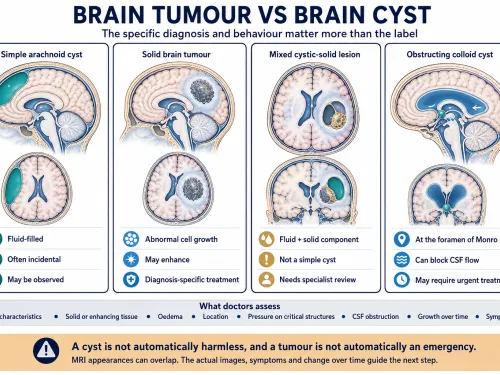
A scan showing a mass is the start of a diagnostic process, not the end. Doctors assess its location, size, imaging characteristics, swelling around it and effect on nearby structures. Depending on the likely diagnosis, further tests may include contrast imaging, functional or vascular imaging, hormone testing for sellar lesions, or imaging elsewhere in the body. Tissue diagnosis through biopsy or surgery may be needed because brain tumour treatment depends on the actual tumour type and molecular features.

Why early evaluation can matter

Early evaluation does not mean that every symptom needs an immediate MRI. It means that persistent or progressive neurological change should not be repeatedly attributed to stress, cervical disease, age or migraine without reconsidering the diagnosis. A small tumour in a functionally important location can be clinically significant, while a larger slow-growing lesion in another location may produce few symptoms. Timely assessment allows treatment planning before neurological function deteriorates further.

A practical way to decide what to do

  1. If the symptom is sudden or disabling, treat it as an emergency rather than waiting for a clinic appointment.
  2. If the symptom is new and progressive over days or weeks, arrange a neurological evaluation.
  3. If you have a long-standing headache disorder but its pattern has changed, document the change and discuss whether imaging is appropriate.
  4. If a scan has already shown a lesion, take the actual images as well as the report for specialist review; management often depends on details visible on the images.

Location often explains the symptom pattern

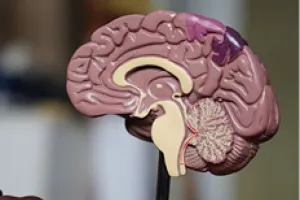
A tumour in the frontal lobe may first appear as a change in judgement, initiative, behaviour or strength rather than headache. A lesion involving the dominant temporal or frontal language network can cause word-finding difficulty or impaired understanding. Tumours close to the motor cortex may produce weakness or focal seizures, while lesions affecting the occipital lobe can cause loss of part of the visual field. Posterior fossa tumours may disturb balance, coordination or cerebrospinal-fluid flow. These patterns are not diagnostic by themselves, but they help a clinician decide which symptoms deserve imaging and how urgently.

What families often notice before the patient does

Some neurological changes are easier for relatives to recognize. A family member may notice that the patient is unusually apathetic, repeats questions, makes uncharacteristic decisions, walks with a new imbalance or has subtle weakness of one hand. Because these changes can be mistaken for stress, ageing or fatigue, a short written timeline is useful. Progressive change over several weeks carries a different significance from a single bad day.

What to record before the consultation

Note when each symptom first appeared, whether it is continuous or episodic, whether it is worsening, and whether there were seizures, vomiting, visual changes or loss of consciousness. Bring a list of current medicines, especially anticoagulants, steroids and anti-seizure drugs. If imaging has already been done, bring the actual images rather than relying only on the report. A precise chronology often helps the specialist distinguish a slowly evolving structural problem from a primary headache, metabolic issue or transient event.

Common Patient Questions

Does every brain tumour cause headache?

No. Some patients have seizures, weakness, visual symptoms or cognitive change without significant headache, and some tumours are found incidentally.

Can a normal neurological examination rule out a brain tumour?

Not completely. It lowers concern in many situations, but imaging may still be appropriate when the history contains clear red flags or a progressive change.

Is dizziness usually a sign of a brain tumour?

No. Dizziness is common and has many ear, cardiovascular, medication and neurological causes. Persistent imbalance with other focal neurological signs deserves assessment.

Should every new headache be scanned?

No. Imaging is selected according to age, examination findings, headache pattern and red flags. Typical stable migraine with a normal examination often does not require routine imaging.

Can a benign brain tumour still be serious?

Yes. “Benign” describes tumour biology, but location and pressure on critical brain structures can still make treatment necessary.

For patients in Noida and the wider region

Patients from Noida, Greater Noida, Ghaziabad and Delhi NCR can usually begin with a neurological assessment and appropriate imaging locally. Patients travelling from other parts of Uttar Pradesh, Madhya Pradesh or Bihar may find it useful to carry previous scans, reports, medication lists and a short timeline of symptoms so that repeat testing can be minimized.

Editorial medical references

  • AANS: Brain Tumors
  • American Migraine Foundation: Headache, MRI and Brain Imaging
  • NCI: Adult Central Nervous System Tumors Treatment

A common misconception

A brain tumour headache is not defined by a single feature such as being worse in the morning. Modern neurology assesses the pattern of change, associated neurological symptoms and neurological examination, rather than any single headache characteristic.

Share this post

Do not find what you're looking for?

Our specialists are here to help. Get expert answers tailored to your condition—no waiting, no guesswork