




Early Symptoms of a Brain Aneurysm: What to Watch For

Quick answer

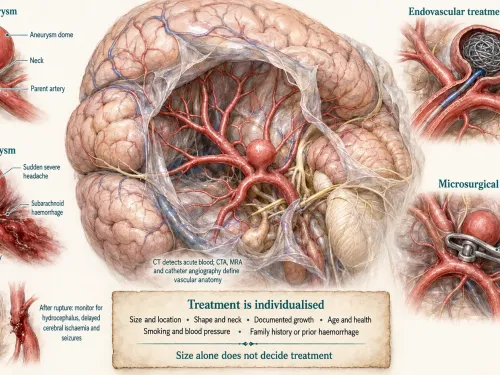
Most unruptured brain aneurysms do not cause symptoms. When they do, the picture usually reflects pressure on nearby structures. A new drooping eyelid with double vision, a dilated pupil or persistent focal headache in a specific area may prompt evaluation. A sudden, unusually severe, thunderclap headache is a rupture warning and needs emergency care.

Show More

The most important fact: many aneurysms are silent

Searching for “early symptoms” can create a false expectation that an aneurysm reliably warns a person before rupture. Most small unruptured aneurysms cause no symptoms. They may be found during imaging for headache, trauma or another unrelated problem. This is why the absence of warning symptoms cannot be used to confirm that a person does or does not have an aneurysm.

Symptoms an unruptured aneurysm can produce

A larger or strategically located aneurysm may compress cranial nerves or nearby brain structures. Possible symptoms include pain above or behind one eye, double vision, drooping eyelid, a newly enlarged pupil, visual change, facial numbness or weakness. The exact pattern depends on the artery and structures involved. These symptoms have many other causes, but a new cranial-nerve pattern should be assessed promptly.

What is a warning or sentinel headache?

A small leak can occasionally precede a major aneurysm rupture and produce a sudden unusual headache. This is sometimes called a sentinel or warning headache. It is important not to overstate how often this occurs: only a minority of patients report such a warning event. A sudden headache that is dramatically different from previous headaches deserves urgent assessment even if it improves.

Symptoms of rupture

Rupture causes bleeding around or within the brain. Some patients remain awake with severe headache; others deteriorate rapidly. There is no safe way to judge the amount of bleeding from pain intensity alone. Rapid CT-based evaluation is more important than waiting to see whether pain settles with medication.

Should recurrent ordinary headaches make you worry about an aneurysm?

Not usually. Migraine and tension-type headache are far more common than aneurysm-related headache. A long-standing stable headache pattern without neurological red flags is not typical of a leaking aneurysm. Concern rises when there is an abrupt new headache, a major change in pattern, new neurological deficits or examination findings that suggest a vascular problem.

Who should discuss aneurysm screening?

Routine screening of everyone with headache is not appropriate. Screening may be considered in selected people with a strong family history of aneurysm or subarachnoid haemorrhage and in some inherited conditions associated with aneurysms. The decision should account for age, family pattern, other vascular risk factors and what would be done if an aneurysm were found.

What to do when an aneurysm is found incidentally

An incidental aneurysm does not automatically require a procedure. Specialist review should assess its size, location, neck, shape, irregularity, growth if prior imaging exists, and the patient’s age and risk factors. Some are monitored; others are treated with endovascular techniques or microsurgical clipping. Blood pressure control and smoking cessation are especially relevant during observation.

A simple action plan

  1. Thunderclap headache: seek emergency care immediately.
  2. New eye movement problem, drooping eyelid or double vision: arrange urgent neurological assessment, especially if accompanied by pain.
  3. Stable familiar migraine without red flags: discuss with your usual clinician rather than assuming an aneurysm.
  4. Known unruptured aneurysm: follow the imaging and risk-factor plan agreed with the treating neurovascular team.

Why symptom-based self-screening does not work

Because many aneurysms are silent, checking for headache, eye pain or dizziness cannot reliably identify who has one. At the same time, these symptoms are common in people without aneurysms. This combination creates a high risk of unnecessary anxiety. Aneurysm detection is based on vascular imaging performed for a clinical reason or a considered screening decision in a higher-risk person.

Eye symptoms deserve particular attention when they are new

A painful third-nerve palsy, classically with drooping eyelid, double vision and an enlarged pupil, can be associated with an aneurysm in a relevant location and warrants urgent vascular evaluation. Not every eyelid droop or double vision is vascular, but the combination of acute eye-movement dysfunction and headache should not be managed by watchful waiting at home.

What not to do after a sudden unusual headache

Do not rely on temporary improvement after an analgesic as proof that the headache was harmless. Do not drive yourself if there has been collapse, confusion, visual loss or severe neurological symptoms. And do not postpone evaluation until the next day because the pain is settling. The key diagnostic window is the acute presentation, when CT and vascular imaging can identify bleeding and its cause.

For a known aneurysm, new symptoms should be interpreted against baseline

Many patients with an incidental aneurysm later become understandably alert to every headache. A stable familiar migraine may be unrelated, while a new thunderclap headache or new cranial-nerve symptom changes the situation. The treating team should give the patient a clear plan for which symptoms require emergency care and which can be discussed during routine follow-up.

Family history should be described precisely

Saying “aneurysms run in my family” can mean very different things. The relevant history includes which relatives were affected, whether they had a proven intracranial aneurysm or subarachnoid haemorrhage, and their age at diagnosis. Multiple first-degree relatives carry more weight than a distant relative with an uncertain diagnosis. Precise family information helps decide whether screening is worth discussing.

An incidental aneurysm can affect anxiety as much as physical health

Once an aneurysm is discovered, some patients restrict exercise, travel or work far more than necessary. A clear follow-up plan should include not only imaging intervals but also practical guidance on blood pressure, physical activity, smoking, medication and what symptoms truly require emergency care. This prevents the diagnosis from becoming a source of constant fear while still respecting its vascular significance.

Why routine CT of the brain is not the same as aneurysm screening

A standard non-contrast CT can detect acute bleeding but may not reliably define an unruptured aneurysm. Vascular imaging such as CT angiography or MR angiography is used when the clinical question is specifically about cerebral arteries. This distinction matters because a previous “normal CT” does not necessarily mean that the vessels were evaluated in detail.

If a clinician recommends vascular imaging, ask what question the test is intended to answer. Imaging is most useful when it is tied to a specific symptom pattern, family-risk discussion or known vascular finding rather than used as a general reassurance test.

Common Patient Questions

Can an aneurysm cause mild headaches for months?

Aneurysms are not a common explanation for chronic stable headache. A new or changing pattern should be assessed on its own clinical merits.

What does a leaking aneurysm headache feel like?

It is typically sudden and unusual, but symptoms vary. Any abrupt severe headache should be evaluated urgently rather than self-diagnosed.

Can an eye symptom be the first sign?

Yes. Selected aneurysms can compress nerves controlling eye movement or pupil size, causing double vision, eyelid droop or pupil asymmetry.

If an aneurysm is found, must it be treated immediately?

No. Some unruptured aneurysms are observed after individualized rupture-risk and treatment-risk assessment.

Can controlling blood pressure help?

Good blood pressure control is an important part of vascular risk management and is particularly relevant when an aneurysm is being observed.

For patients in Noida and the wider region

For sudden severe headache in Noida/NCR, emergency assessment should take priority over choosing a distant specialist. For an incidental aneurysm found on a stable outpatient scan, patients from Noida, Greater Noida, Ghaziabad, UP, MP or Bihar can arrange planned review with the original CTA/MRA images and any earlier scans for comparison.

Editorial medical references

  • NINDS: Cerebral Aneurysms
  • AANS: Cerebral Aneurysm

A common misconception

Not every severe headache means a brain aneurysm. The key features are sudden onset, unusual severity for the individual, and the absence of a familiar pattern.

Do not find what you're looking for?

Our specialists are here to help. Get expert answers tailored to your condition—no waiting, no guesswork