

Spine Surgery for Back Pain: When Is It Considered and What Are the Options?

Quick answer

Spine surgery is more likely to help back pain when there is a clearly identifiable structural cause, such as nerve root compression, instability, deformity or spinal cord compression, that explains the symptoms and has not responded to appropriate non-surgical care. Non-specific back pain without a definable structural driver usually responds better to a structured rehabilitation programme than to surgery.

Show More

Image
Spine Surgery for Back Pain

Why “back pain surgery” is too broad a term

Back pain can arise from muscle, joints, discs, fractures, inflammatory disease, infection, tumour, hip pathology and many other causes. A large proportion is nonspecific and improves without surgery. Operations are most useful when they solve a defined anatomical problem, such as a disc fragment compressing a nerve, severe stenosis limiting walking, instability with neural compression, a fracture that cannot maintain alignment, or a tumour causing pressure on the spinal canal.

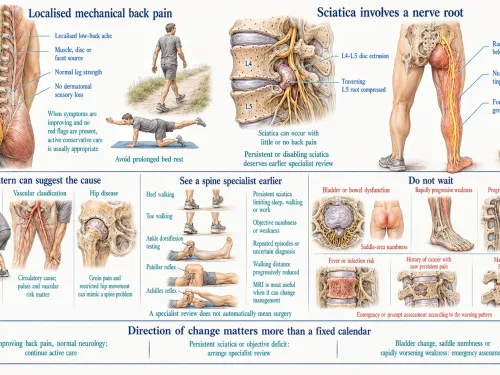
First separate back pain from nerve pain

Leg pain from nerve-root compression often behaves differently from axial low-back pain. Sciatica may be sharp, electric or burning and can travel below the knee with numbness or weakness. Spinal stenosis may cause heaviness or pain in the legs during standing and walking that improves with sitting or bending forward. These patterns are often more surgically targetable than diffuse back ache without a clear structural correlate.

Common operations and the problems they address

When decompression alone may be enough

If the main problem is nerve compression and the spine is stable, decompression without fusion may be sufficient. Examples include a straightforward herniated disc or selected cases of stenosis. Preserving motion and avoiding unnecessary instrumentation can reduce surgical burden. Whether decompression could create instability depends on anatomy and how much bone or joint must be removed.

When fusion enters the discussion

Fusion is designed to eliminate pathological movement and stabilize the spine. It may be appropriate when there is demonstrable instability, deformity, destructive disease or when decompression itself would make a segment unstable. It should not be added simply because back pain is chronic. Surgeons should be able to show the instability or structural rationale and explain why a non-fusion approach would be insufficient.

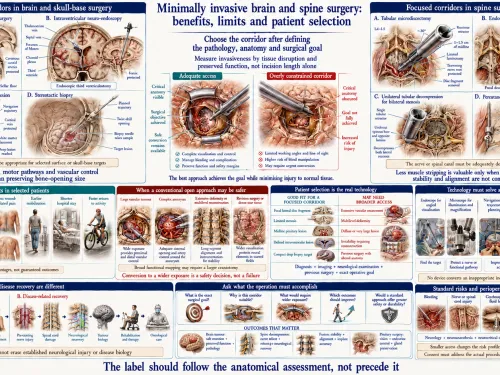
What about minimally invasive surgery?

Minimally invasive techniques use smaller access corridors, tubular retractors, endoscopes or percutaneous instrumentation to reduce soft-tissue disruption in selected operations. Potential advantages include less blood loss, less muscle injury and earlier mobilisation. These benefits depend on the operation and patient. A small incision is not useful if it compromises decompression or makes a complex reconstruction less safe.

Disc replacement is a selective option

Artificial disc replacement is intended to preserve motion after removal of a diseased disc. Candidacy depends on level, facet-joint health, bone quality, alignment, instability and the exact pain generator. It is not a general alternative to fusion for every patient with degeneration. Careful selection is essential because an implant cannot compensate for a wrong diagnosis.

Questions that should be answered before any operation

  1. What exact structure is causing my symptoms?
  2. Do my examination and MRI findings match?
  3. What is the operation expected to improve: back pain, leg pain, weakness, walking or stability?
  4. What non-surgical treatments remain reasonable?
  5. Why is fusion necessary, if it is being proposed?
  6. Can the goal be achieved with decompression alone or a smaller-access approach?
  7. What symptoms may remain even after technically successful surgery?

Red flags change the timeline

What predicts a useful result?

The strongest foundation is diagnostic concordance: symptoms, examination and imaging all point to the same problem, and the proposed operation directly corrects it. Smoking, uncontrolled diabetes, poor bone quality, severe deconditioning and unrealistic expectations can affect recovery and complication risk. Optimising these factors can be as important as choosing the technique.

Recovery is part of the treatment plan

Recovery varies from early walking after a focused decompression to a longer rehabilitation process after fusion or deformity correction. The plan should cover wound care, pain medication, return to driving, work restrictions, graded strengthening and warning signs. Surgery creates the mechanical opportunity for recovery; it does not replace rehabilitation.

Why imaging correlation is especially important in chronic back pain

A patient can have several abnormal levels on MRI, but only one may be clinically relevant, and sometimes none explains the pain convincingly. Disc degeneration, Modic changes, facet arthritis and mild stenosis are common findings. Surgery becomes more defensible when the pain pattern, examination, imaging and, in selected cases, response to diagnostic injections point to the same structure.

Fusion should solve instability, not uncertainty

When the source of pain is unclear, adding screws and rods does not make the diagnosis more certain. Fusion is most rational when there is a well-defined unstable or painful segment, deformity, destructive disease or a decompression that would otherwise destabilize the spine. The number of fused levels should be justified because each additional level changes motion and surgical burden.

Bone health can determine which operation is safe

Osteoporosis increases the risk of fixation failure, vertebral fracture and problems at adjacent levels. In older patients or those with risk factors, bone-density assessment and treatment may be necessary before elective instrumentation. A technically elegant fusion performed in poor-quality bone can fail mechanically, so metabolic bone health belongs in preoperative planning.

Weight, diabetes and smoking affect recovery

Obesity can increase wound and anaesthetic challenges, diabetes can increase infection risk when poorly controlled, and smoking interferes with bone healing. These factors do not automatically exclude surgery, but they change the risk conversation and can guide prehabilitation. Improving glucose control, stopping tobacco and building walking capacity before elective surgery may improve the recovery environment.

How to interpret the promise of “motion preservation”

Disc replacement can preserve motion at a treated level, but it is not appropriate when there is major facet arthritis, instability, deformity or poor bone quality. Likewise, a non-fusion decompression preserves motion only if adequate decompression can be achieved without destabilizing the segment. Motion preservation is a means, not an objective that overrides neurological safety.

Postoperative rehabilitation differs by operation

After a focused decompression, patients often begin walking early and progress activity relatively quickly. Fusion requires more attention to bone healing and staged loading. Deformity reconstruction has a longer recovery horizon and can involve intensive rehabilitation. Patients should ask about the expected course for their exact procedure rather than using another person’s recovery from a different operation as a comparison.

Adjacent-segment disease should be discussed without exaggeration

After fusion, the levels above and below continue to move and age. Some patients later develop symptomatic degeneration at an adjacent level, but degeneration also occurs naturally in people who never have fusion. The possibility should be part of informed consent without being presented as an inevitable consequence. Limiting fusion to the levels that genuinely need stabilization helps preserve motion where possible.

Revision surgery has a different risk profile from first-time surgery

Scar tissue, altered anatomy, previous implants and reduced bone stock can make revision operations more complex. Before recommending another procedure, the team should establish whether symptoms arise from recurrent compression, non-union, adjacent disease or another source. Sometimes the correct decision is revision decompression or reconstruction; sometimes the previous fusion is solid and the pain generator lies elsewhere.

A patient should understand the expected magnitude of benefit

For a well-localized disc herniation, the goal may be substantial relief of leg pain. For lumbar stenosis, the target may be improved walking tolerance. For deformity, the aim may include balance and function as well as pain. For chronic axial back pain, predicted benefit is often less certain. The more uncertain the expected gain, the more carefully the operative burden and alternatives should be weighed.

Why “successful fusion” and “successful patient outcome” are not identical

X-rays can show a solid fusion while the patient still has pain from another source, and a patient can feel functionally much improved before the fusion is fully mature. Radiological healing is one outcome among several. Pain, walking, neurological function, work capacity and medication use should also be followed. This broader view prevents the implant image from becoming the only measure of success.

Common Patient Questions

Can surgery help nonspecific low-back pain?

Sometimes a specific pain generator can be identified, but surgery is less predictable when pain is diffuse and no concordant structural problem exists.

Is fusion stronger than decompression?

They solve different problems. Fusion stabilizes; decompression relieves pressure. Adding fusion is useful only when stabilization is genuinely needed.

Is minimally invasive surgery always preferable?

No. It is valuable when it achieves the same surgical objective safely with less tissue disruption. Complex anatomy may be better served by another approach.

Can a disc replacement avoid fusion?

In selected patients, yes. Suitability depends on anatomy, level, facet joints, alignment, bone quality and diagnosis.

Will spine surgery stop all future degeneration?

No. Surgery treats the targeted problem. Other spinal segments continue to age and can develop symptoms later.

How should I compare two different surgical opinions?

Ask each surgeon to identify the pain generator, objective indication, exact goal, need for implants and realistic alternatives. Differences often become clearer when those points are compared.

For patients in Noida and the wider region

For patients in Noida, Greater Noida, Ghaziabad and Delhi NCR, the aim of a spine opinion should be to establish whether back pain has a surgically correctable cause before discussing implants or techniques. Patients travelling from UP, MP or Bihar should carry MRI/CT images, dynamic X-rays if performed, bone-density information when relevant and records of prior injections, therapy or surgery.

Editorial medical references

  • AANS: Herniated Disc
  • AANS: Minimally Invasive Spine Surgery
  • AANS: Artificial Lumbar Disc Surgery

A common misconception

A successful spine operation is not defined by absence of any pain forever. It is defined by achieving the goal set before surgery, such as relieving leg pain, restoring function or preventing further neurological decline.

Do not find what you're looking for?

Our specialists are here to help. Get expert answers tailored to your condition—no waiting, no guesswork