

Signs That Spine Surgery May Need to Be Considered

Quick answer

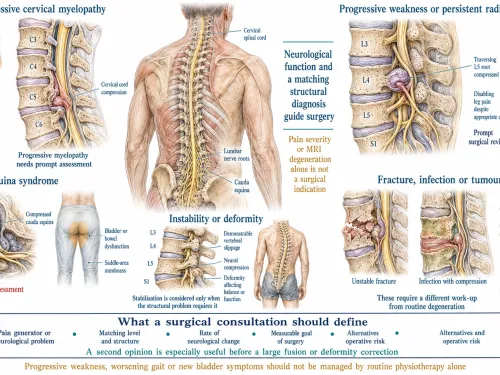
Signs that a spine problem may need surgical evaluation include progressive neurological weakness, disabling nerve root pain that persists despite an adequate trial of appropriate non-surgical care, new bladder or bowel dysfunction with saddle-area numbness, and severe instability or deformity affecting function. These features shift the balance from continued conservative care towards structured surgical review.

Show More

Pain alone is not the whole decision

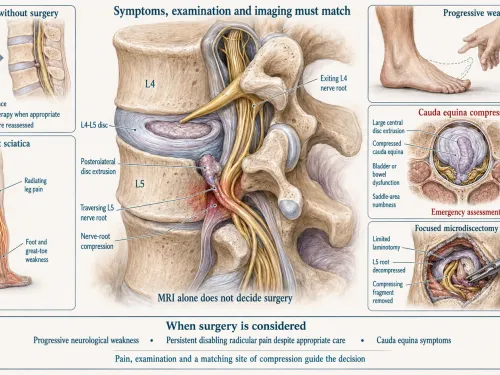
Many people with back or neck pain never need surgery. The decision becomes more specific when pain is linked to nerve-root compression, spinal cord compression, deformity, instability, fracture, infection or tumour. The strongest surgical indications are generally based on neurological function and a concordant structural diagnosis rather than pain severity alone.

1. Progressive weakness

Worsening motor weakness is one of the clearest reasons for prompt specialist review. Examples include a progressing foot drop, loss of grip strength, increasing difficulty lifting the arm, or weakness that is affecting walking. The urgency depends on the cause, severity and rate of change. Stable mild weakness and rapidly worsening weakness are not the same clinical situation.

2. Bladder, bowel or saddle sensory change

3. Signs of spinal cord compression

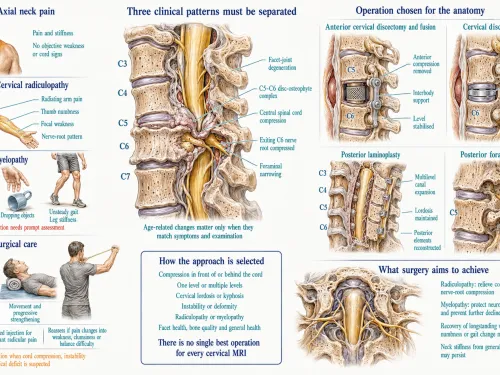
Cervical or thoracic cord compression can produce hand clumsiness, dropping objects, difficulty with buttons or handwriting, unsteady walking, leg stiffness, abnormal reflexes or bladder symptoms. This pattern is different from ordinary neck or back pain. When myelopathy is progressive, decompression may be considered to prevent further neurological decline.

4. Persistent nerve pain that remains disabling

A patient can have severe sciatica or arm pain yet retain normal strength. If a reasonable course of non-surgical treatment fails and MRI shows compression that accurately matches the symptoms, surgery may be considered to improve pain and function. The decision depends on how much the symptoms interfere with walking, sleep, work and daily life, and whether continued waiting is likely to help.

5. Structural instability or deformity

Some patients have vertebral slippage, deformity or instability that causes neural compression or mechanical symptoms. In these cases decompression alone may not address the problem, and stabilization or fusion can be discussed. Instability should be demonstrated clinically and radiologically; implants are not a routine solution for nonspecific back pain.

6. Fracture, infection or tumour

Spine surgery can also be necessary for conditions outside ordinary degeneration. A fracture may need stabilization or decompression, an infection may need drainage or debridement in selected cases, and a spinal tumour may need tissue diagnosis, decompression or reconstruction. These conditions require a different work-up from routine disc disease.

7. Repeated deterioration despite appropriate treatment

Some patients cycle through repeated episodes of severe radiculopathy or neurogenic claudication that progressively reduce function. If imaging shows a correctable structural problem and the non-surgical pathway has been properly completed, surgery may offer a more durable functional improvement. The benefit should still be weighed against operative risk and the patient’s goals.

What is not a good reason by itself?

  • An MRI report mentioning “degeneration” without matching symptoms.
  • A disc bulge in a person whose pain pattern does not fit the affected nerve.
  • Age-related changes without neurological compromise or functional limitation.
  • The belief that surgery will make the spine “new” or prevent all future back pain.
  • Failure of passive treatments alone when an appropriate active rehabilitation programme has not been tried.

What a surgical consultation should clarify

The surgeon should define the pain generator or neurological problem, show the relevant imaging finding, explain the exact goal of the operation and discuss alternatives. A good consultation also separates what surgery is likely to improve from symptoms that may persist. For example, decompression for stenosis may improve leg pain and walking more predictably than longstanding nonspecific low-back pain.

Age-related MRI changes are not a surgical indication

Degenerative changes accumulate with age, so a report may list multilevel disc desiccation, osteophytes and facet arthropathy even in someone whose symptoms are mild. Surgery is considered for the level and structure that explain the clinical problem. Operating on every abnormal level can increase risk and reduce motion without adding benefit.

A second opinion is especially useful when the operation is large

If a patient has been advised multilevel fusion, deformity correction or surgery for predominantly axial pain, another specialist opinion can clarify whether the diagnosis and extent of surgery are agreed upon. A second opinion is not a vote against surgery. It is a way to confirm the structural indication, understand alternative approaches and compare expected functional gains.

Medical fitness can change timing but not the diagnosis

Diabetes control, smoking, anaemia, nutrition, bone density and cardiovascular status affect surgical risk and healing. Elective surgery may be delayed to optimize these factors. In a neurological emergency, however, the balance can shift toward earlier intervention despite medical risk. The team must separate what can be optimized from what cannot safely wait.

The goal should be measurable

Before surgery, define what success would look like: longer walking distance, relief of radicular pain, preservation of hand function, recovery of strength or stabilization of a fracture. Vague goals such as “fix the spine” are difficult to evaluate and create unrealistic expectations. A measurable goal keeps the treatment aligned with the patient’s actual disability.

Persistent symptoms after previous spine surgery require a new diagnosis

Pain after an earlier operation can come from recurrent disc herniation, adjacent-level disease, scar tissue, non-union, implant problems, hip pathology or a pain generator unrelated to the original diagnosis. Revision surgery should not be planned simply because symptoms returned. Updated examination and imaging should identify what has changed and whether another operation has a correctable target.

Neurological preservation may be the main reason for surgery even when pain is tolerable

Some patients with cervical myelopathy have little pain but progressive gait or hand dysfunction. In that setting, the operation is not primarily a pain procedure. Its purpose is to decompress the spinal cord and protect function. This distinction is crucial because waiting for severe pain before seeking help can delay treatment of a neurological problem.

Surgery may be deferred when the target is unclear

Sometimes symptoms are severe but imaging shows several modest abnormalities and none clearly matches the examination. In that situation, more diagnostic work can be safer than choosing the most abnormal-looking level. Targeted rehabilitation, selective injections, nerve studies or evaluation of hip and peripheral nerve causes may clarify the pain generator before an irreversible operation is considered.

Common Patient Questions

Does severe back pain mean I need surgery?

No. Pain severity alone does not establish a surgical lesion. Neurological findings, diagnosis and response to treatment matter.

Is numbness an indication for surgery?

Persistent numbness may reflect nerve compression, but urgency depends on progression, associated weakness and the underlying cause.

What is myelopathy?

Myelopathy means dysfunction of the spinal cord, commonly from cervical compression. It can affect hand dexterity, balance, walking and reflexes.

Do all spinal stenosis patients need surgery?

No. Mild or stable symptoms can often be managed non-surgically. Surgery is more relevant when walking or neurological function is significantly affected.

Can physiotherapy replace surgery in progressive cord compression?

Exercise can support conditioning, but it cannot mechanically decompress a spinal cord that is progressively compromised. The structural problem requires specialist assessment.

For patients in Noida and the wider region

Patients in Noida/NCR with progressive weakness, gait deterioration or bladder symptoms should seek prompt evaluation rather than continuing routine physiotherapy without reassessment. Patients travelling from UP, MP or Bihar should bring MRI or CT images, previous operative notes if any, and a clear timeline of neurological change.

Editorial medical references

  • AANS: Herniated Disc
  • AANS: Cervical Spine

A common misconception

An abnormal MRI report is not, by itself, a sign that surgery is needed. Many people without pain have imaging findings, and many surgical decisions turn on symptoms and examination in addition to imaging.

Do not find what you're looking for?

Our specialists are here to help. Get expert answers tailored to your condition—no waiting, no guesswork