


Cervical Spondylosis Treatment: Available Options and When Surgery May Be Needed

Quick answer

Most patients with cervical spondylosis do not need surgery. Treatment usually starts with structured physiotherapy focused on posture and neck-shoulder mechanics, ergonomic changes, analgesia and, in selected patients, injections. Surgery is considered when there is progressive neurological weakness, signs of cervical myelopathy such as hand clumsiness or gait disturbance, or radicular pain that does not respond to appropriate conservative care.

Show More

Image
Cervical Spondylosis Treatment


Cervical spondylosis is common, but symptoms vary

With age, cervical discs lose water content and height, facet joints develop arthritic change and bone spurs can form. These changes are common on X-rays and MRI and do not automatically represent disease requiring treatment. Symptoms occur when degeneration becomes painful, narrows a nerve exit or compresses the spinal cord.

Three clinical patterns need to be separated

Non-surgical treatment for neck pain and radiculopathy

Treatment is tailored to the dominant problem. A short period of relative activity modification can reduce irritation, but prolonged immobilisation is usually unhelpful. Medication may be used for pain or inflammation when medically appropriate. Physiotherapy can improve neck and shoulder mechanics, strength, movement confidence and general conditioning. Some patients with radicular pain may benefit from carefully selected injections, although these do not remove structural compression.

When symptoms suggest spinal cord involvement

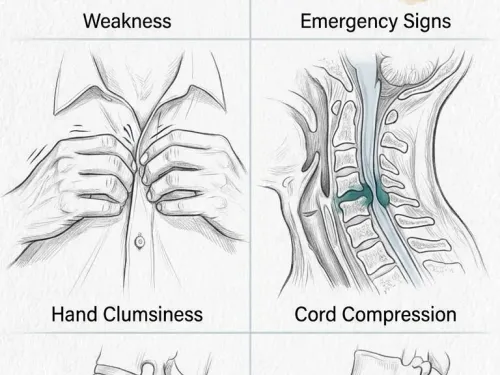
Myelopathy is more important than ordinary neck pain because the spinal cord itself is affected. Early clues can be subtle: difficulty with shirt buttons, handwriting deterioration, dropping objects, loss of hand dexterity, unsteady walking or a feeling that the legs are stiff. Examination may show brisk reflexes or other long-tract signs. When cord compression and neurological dysfunction are present, simply treating pain can miss the main problem.

When surgery may be recommended

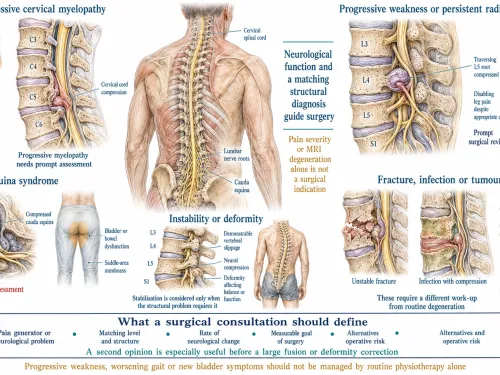
  • Progressive weakness in an arm or leg due to cervical nerve or cord compression.
  • Clinical myelopathy with significant spinal cord compression, especially when function is worsening.
  • Persistent disabling arm pain despite an appropriate course of non-surgical treatment and a matching compressive lesion.
  • Instability, deformity or alignment problems that contribute to neural compression.
  • Rare emergencies such as acute major neurological deterioration or another destructive process.

Common surgical approaches

Anterior cervical discectomy and fusion

Through a front-of-neck approach, the diseased disc and compressive material are removed. The level is then stabilized with an interbody graft or cage, often with fixation. This is commonly used for disc and osteophyte compression at one or more levels when anatomy is suitable.

Cervical disc replacement

In selected patients, an artificial disc can preserve motion instead of fusing a level. Suitability depends on age, facet-joint condition, alignment, level, bone quality and the pattern of degeneration. Severe spondylosis or instability may make disc replacement inappropriate.

Posterior decompression procedures

Laminoplasty, laminectomy with or without fusion, and posterior foraminotomy are examples of operations performed from the back of the neck. The choice depends on the number of levels, alignment, location of compression and whether stabilization is needed.

How surgeons choose an approach

No single operation suits all cervical spondylosis. Doctors assess whether the compression is mainly in front of or behind the cord, how many levels are involved, whether the neck retains normal lordosis, whether there is instability, and whether symptoms are radicular or myelopathic. Bone quality, swallowing risk, previous surgery and general health also matter.

What surgery can and cannot promise

For myelopathy, a major goal is often to stop further neurological deterioration; recovery already lost may be incomplete, particularly when symptoms have been severe or long-standing. Radicular arm pain may improve more predictably after adequate decompression. Neck stiffness from generalized degeneration can persist even when nerve or cord compression has been successfully treated.

Medication and therapy should match the clinical pattern

Simple neck pain may respond to short courses of analgesic or anti-inflammatory medication when safe, heat, movement and active rehabilitation. Radicular arm pain may require a more nerve-focused plan. Myelopathy is different: medication can reduce pain but cannot enlarge a canal that is mechanically compressing the spinal cord. Recognising the pattern prevents months of symptom treatment while neurological function declines.

Why forceful neck manipulation deserves caution

Gentle mobility and strengthening can be useful for uncomplicated neck pain. In a patient with significant canal stenosis, cord compression, instability or neurological deficit, forceful manipulation should not be undertaken without appropriate medical assessment. The concern is not that all movement is dangerous, but that high-velocity techniques may be inappropriate when the spinal cord has little reserve space.

Myelopathy can progress even when pain is modest

Patients sometimes delay evaluation because their neck does not hurt much. Cord compression can instead present through dexterity and gait. Once myelopathy is established, the clinical question is often whether decompression can prevent further decline and allow some recovery. Longstanding severe cord dysfunction is less likely to reverse completely, which is why the functional history matters.

Choosing between anterior and posterior surgery

An anterior approach is often useful when compression is mainly from discs and osteophytes in front of the cord at a limited number of levels. Posterior decompression can be useful for multilevel stenosis when alignment is favourable. Fusion may be added when instability or alignment requires it. These are anatomical decisions, and there is no single approach that should be applied to every multilevel MRI.

Swallowing, voice and other approach-specific considerations

Anterior cervical surgery passes near the oesophagus, trachea and recurrent laryngeal nerve, so temporary swallowing discomfort or voice change can occur. Posterior surgery has a different pattern of muscle pain and can carry a risk of postoperative axial discomfort. Patients should understand the risks specific to the chosen corridor rather than hearing only a generic list of “spine surgery risks.”

Recovery after decompression

Arm pain may improve early when a nerve root has been adequately decompressed. Hand dexterity, gait and numbness from myelopathy may recover gradually and incompletely. Physiotherapy focuses on safe mobility, shoulder and neck function, balance and general strength. Follow-up imaging is selected according to procedure and symptoms rather than obtained routinely at every visit.

When observation is reasonable even with canal narrowing

Some patients have radiological cervical stenosis without clinical myelopathy. They may be managed with education about warning symptoms, periodic neurological review and sensible activity guidance rather than immediate surgery. The threshold changes if hand dexterity, gait or power begins to decline. This distinction prevents treatment of the scan while still respecting the risk of future cord dysfunction.

Why follow-up after conservative care needs a neurological checkpoint

A patient treated for neck pain or radiculopathy should be reassessed if symptoms evolve from pain into weakness, clumsiness or balance difficulty. Continuing the same physiotherapy plan despite a new neurological pattern can delay recognition of myelopathy. Follow-up should therefore ask not only “is the pain less?” but also “is function stable?”

Common Patient Questions

Can cervical spondylosis be cured permanently?

Age-related degeneration cannot be reversed completely. Treatment aims to control symptoms, protect neurological function and address specific compression or instability when needed.

Is physiotherapy safe with cervical spondylosis?

Usually, when tailored to the diagnosis. Aggressive manipulation should be avoided when there is significant cord compression or neurological deficit unless specifically cleared by the treating clinician.

Does numbness in the hand mean neck surgery?

No. Hand numbness can come from cervical nerves, carpal tunnel syndrome and other causes. Examination and sometimes nerve testing help distinguish them.

What is the difference between radiculopathy and myelopathy?

Radiculopathy affects a nerve root and often causes arm pain, numbness or focal weakness. Myelopathy reflects spinal cord dysfunction and can affect hands, balance and legs.

Can myelopathy improve after surgery?

Many patients improve, but the main aim can be to prevent further decline. Recovery depends on severity and duration of cord dysfunction.

Is fusion always necessary?

No. Some operations preserve motion or decompress without fusion. Fusion is used when the chosen approach or underlying instability makes stabilization necessary.

For patients in Noida and the wider region

Patients in Noida, Greater Noida, Ghaziabad and Delhi NCR with hand clumsiness, balance problems or progressive limb weakness should seek neurological or spine evaluation rather than assuming symptoms are ordinary cervical stiffness. Patients travelling from UP, MP or Bihar should bring MRI images and, if available, flexion-extension X-rays and previous operative records.

Editorial medical references

  • AANS: Cervical Spine

A common misconception

Cervical spondylosis on an MRI report is not, by itself, a diagnosis that mandates surgery. It is a common finding with increasing age, and its clinical significance depends on symptoms and examination.

Do not find what you're looking for?

Our specialists are here to help. Get expert answers tailored to your condition—no waiting, no guesswork