



Cervical Spondylosis Symptoms: From Neck Pain to Nerve and Spinal Cord Signs

Quick answer

Cervical spondylosis symptoms range from simple mechanical neck pain and stiffness, to arm pain, numbness or tingling in a specific finger pattern indicating a nerve root problem, to hand clumsiness, gait disturbance and balance issues indicating pressure on the spinal cord itself. The severity of symptoms and neurological findings, not the MRI appearance alone, drive management.

Show More

Image
Cervical spondylosis symptoms and neurological warning signs


Common neck symptoms

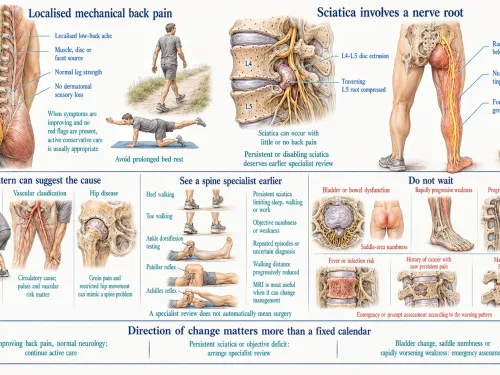
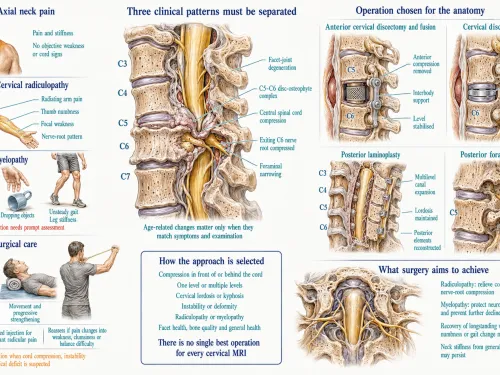
Mechanical cervical spondylosis often causes aching or stiffness in the neck and upper shoulders. Symptoms can be worse after prolonged desk work, driving or sustained neck positions. Some patients notice reduced range of motion or intermittent muscle spasm. These symptoms are common and, in the absence of neurological warning signs, usually begin with conservative treatment.

Symptoms when a nerve root is compressed

Cervical radiculopathy occurs when a nerve root is irritated or compressed by a disc, bone spur or foraminal narrowing. Pain can travel from the neck or shoulder into the arm or hand. Tingling and numbness may follow a particular finger distribution. Weakness can affect shoulder movement, elbow flexion or extension, wrist function or grip depending on the root involved. Coughing or certain neck positions may aggravate symptoms.

Symptoms when the spinal cord is compressed

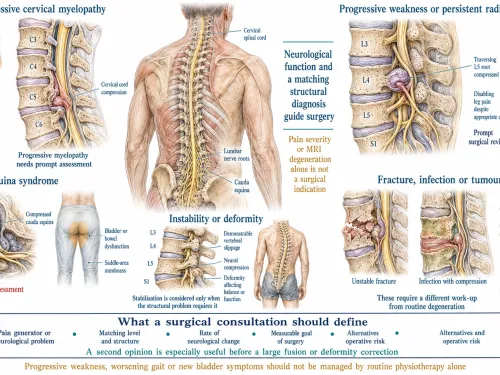
Cervical myelopathy can begin quietly. A patient may first notice loss of fine hand control, difficulty buttoning clothes, a change in handwriting or repeated dropping of objects. Walking can become unsteady, the legs may feel stiff or heavy, and falls can become more frequent. Some patients develop urinary urgency or other bladder symptoms later. Because pain may be mild, myelopathy can be overlooked if attention remains focused only on neck discomfort.

Symptoms that need prompt assessment

  • Progressive arm or leg weakness.
  • New hand clumsiness affecting daily tasks.
  • Increasing balance difficulty or unexplained falls.
  • Leg stiffness or a broad-based, unsteady gait.
  • Loss of bladder control or major new urinary dysfunction with neurological symptoms.
  • Severe neck pain after significant trauma, especially with weakness or numbness.

Why the MRI report can be misleading without examination

Many adults have disc degeneration, osteophytes or canal narrowing without major symptoms. Conversely, a patient with clinically significant cord dysfunction may describe only modest neck pain. The examination looks for motor weakness, sensory change, reflex abnormalities, hand dexterity, gait and long-tract signs. Imaging is then interpreted as the anatomical explanation for those findings rather than as a diagnosis in isolation.

Other problems that can resemble cervical spondylosis

  • Carpal tunnel or ulnar neuropathy causing hand numbness.
  • Shoulder disease producing upper-arm pain and restricted movement.
  • Peripheral neuropathy affecting hands and feet.
  • Neurological disorders that affect gait or limb coordination.
  • Inflammatory, infectious or neoplastic disease of the spine in less common situations.

How symptoms are evaluated

Evaluation begins with history and examination. MRI is the usual study when nerve-root or spinal cord compression is suspected. Plain X-rays can show alignment, disc-space loss and osteophytes; dynamic views may be useful if instability is a concern. CT offers detailed bone information in selected cases. Nerve-conduction studies can help when a peripheral nerve problem is competing with a cervical diagnosis.

What the symptom pattern means for treatment

Simple neck pain is generally treated non-surgically. Stable radiculopathy often improves with conservative care, while persistent disabling pain or progressive weakness can lead to a surgical discussion. Myelopathy requires closer attention because the spinal cord is at risk. The goal of surgery in progressive myelopathy is decompression and protection of neurological function, with recovery depending on how much cord dysfunction is already present.

A useful clue is loss of dexterity rather than loss of strength

Early myelopathy may not produce obvious weakness on simple muscle testing. Patients may instead become slower with buttons, handwriting, using chopsticks or handling coins. They may describe the hands as “stiff” or “not listening.” These functional changes can precede major weakness and should be specifically asked about in anyone with cervical canal narrowing.

Walking symptoms may be subtle at first

Patients may notice they need a handrail on stairs, feel uncertain in the dark, catch a foot on uneven ground or lose confidence with quick turns. Family members may see a stiff or broad-based gait. Because these changes can also occur with vestibular disease, neuropathy or knee and hip problems, neurological examination is needed to identify whether the spinal cord is involved.

Bladder symptoms require context

Urinary urgency is common in older adults and has urological causes, so it is not diagnostic of cervical myelopathy. Concern rises when bladder change appears with hand clumsiness, gait imbalance, leg stiffness or other long-tract signs. Sudden severe bladder dysfunction with acute spinal symptoms is a different emergency pattern and should not be attributed to chronic spondylosis without assessment.

Symptoms can come from more than one level or more than one disease

A patient may have cervical myelopathy and carpal tunnel syndrome at the same time, or cervical radiculopathy with a painful shoulder. This “double pathology” explains why one treatment may improve some symptoms but not all. Careful preoperative counselling should identify which complaints are likely to arise from the neck and which may need separate treatment.

Neck pain severity does not measure cord risk

A patient with severe muscular neck pain may have no spinal cord compression, while another with only mild stiffness may have clear myelopathy. Cord risk is assessed from neurological function and MRI rather than pain score. This is why new dexterity or gait problems should be reported even when neck pain seems manageable.

Symptoms can fluctuate while the underlying compression remains

Patients sometimes have good and bad days and interpret temporary improvement as proof that the cord is no longer at risk. Myelopathic symptoms can fluctuate with fatigue and activity even when structural compression persists. Trend over months and objective examination are more reliable than one day’s symptom intensity.

Arm symptoms can help localize but should not be self-diagnosed by finger charts

Textbook dermatomes are useful guides, yet individual overlap is common. A patient may have pain in the thumb or middle finger that does not map perfectly to a single root. Motor testing, reflexes and MRI correlation are more reliable than using one finger symptom to decide the surgical level. This is particularly important when MRI shows disease at several cervical levels.

Because cervical spondylosis is common, patients should be told which symptoms are being monitored over time. A simple baseline of hand function, walking, strength and reflexes makes later change easier to recognise than relying on memory of how the neck felt months earlier.

Common Patient Questions

Can cervical spondylosis cause headache?

Neck disorders can contribute to cervicogenic headache in some patients, but headache has many causes and should not automatically be attributed to cervical degeneration.

Can it cause dizziness?

Dizziness is not a specific symptom of cervical spondylosis. Vestibular, cardiovascular, medication and neurological causes often need consideration.

Why are my hands numb if my neck does not hurt?

Nerve or cord compression can occur with little neck pain. Peripheral nerve conditions can also cause hand numbness, so examination is needed.

Is arm pain always due to a slipped cervical disc?

No. Bone spurs, foraminal stenosis, shoulder disease and peripheral nerve problems can produce similar symptoms.

What symptom is most concerning?

Progressive weakness, loss of hand dexterity, walking imbalance or bladder changes with neurological symptoms deserve prompt assessment.

For patients in Noida and the wider region

For patients in Noida/NCR, a neurological examination is particularly useful when cervical symptoms include weakness, hand clumsiness or gait change. Patients from UP, MP or Bihar can bring existing cervical MRI and X-rays, but should not delay urgent assessment if neurological function is worsening.

Editorial medical references

  • AANS: Cervical Spine

A common misconception

Neck pain in cervical spondylosis is not, by itself, a sign of nerve or spinal cord damage. It is the accompanying pattern of arm symptoms, weakness or gait change that indicates whether the cord or nerve root is involved.

Do not find what you're looking for?

Our specialists are here to help. Get expert answers tailored to your condition—no waiting, no guesswork