

Slipped Disc Treatment: Surgery or Non-Surgical Care?

Quick answer

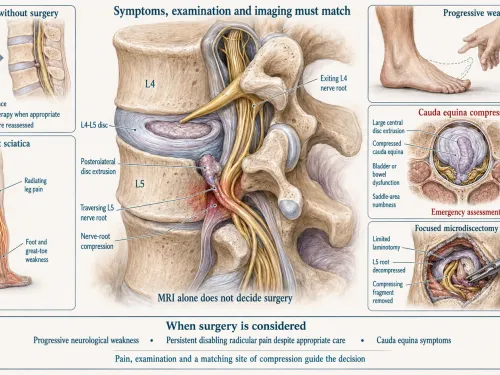
The initial treatment of most slipped discs is non-surgical. This typically includes short activity modification rather than prolonged bed rest, appropriate analgesia, targeted physiotherapy and, in selected patients, an epidural steroid injection. Surgery is offered when there is progressive neurological weakness, persistent disabling leg pain despite adequate conservative care, or an emergency picture such as cauda equina syndrome.

Show More

Start with the symptom, not the MRI

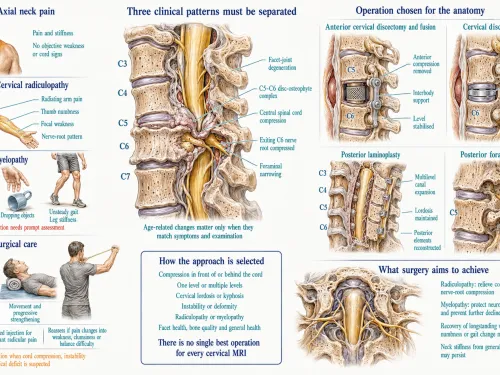
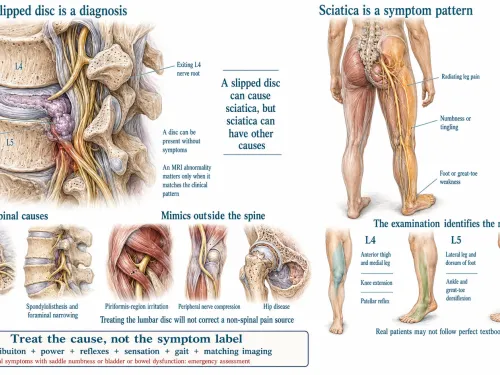
A disc herniation can cause back pain, sciatica, arm pain, numbness or weakness, but similar symptoms can also come from spinal stenosis, hip disease, peripheral nerve problems or other conditions. Treatment is most reliable when the clinical pattern and imaging identify the same compressed nerve. An MRI phrase such as “disc bulge” is not itself a treatment indication.

What non-surgical treatment can achieve

The purpose of conservative treatment is not merely to “tolerate” the disc. It gives inflammation time to settle while maintaining movement and rebuilding function. Many herniated fragments shrink over time. Medication can control pain sufficiently to allow walking and rehabilitation. Physiotherapy can address movement confidence, trunk and hip strength, posture and a graded return to normal loading.

Common non-surgical components

  • Activity modification for a short period while avoiding prolonged bed rest.
  • Pain relief and anti-inflammatory medication when appropriate for the patient’s kidney, stomach, cardiovascular and other medical risks.
  • Physiotherapy with progressive exercise rather than passive modalities alone.
  • Education about safe lifting and a staged return to work or sport.
  • Selective nerve-root or epidural injection for some patients with persistent radicular pain.

What surgery changes

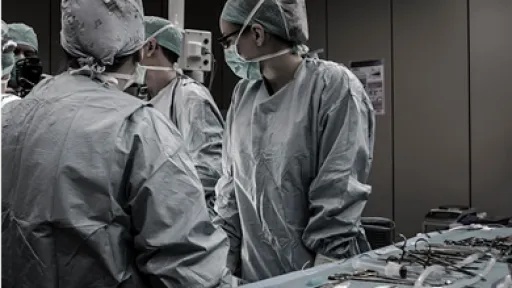
Surgery mechanically decompresses the affected nerve. For a straightforward lumbar herniation, microdiscectomy removes the fragment compressing the nerve through a focused approach. Relief of leg pain can be relatively rapid when the compressed nerve is the true pain generator. Numbness and weakness may recover more slowly because nerve healing takes time. Surgery does not reverse all age-related disc degeneration and does not prevent every future episode of back pain.

Who should not simply keep waiting

New bladder or bowel dysfunction, saddle numbness and progressive weakness require urgent assessment. A patient with severe pain but intact and stable neurological function may have more time to choose between continued conservative care and surgery. A patient with a rapidly worsening motor deficit may not. This distinction is why repeated examination is more useful than applying one fixed waiting period to everyone.

What about minimally invasive or endoscopic surgery?

A smaller-access technique can reduce muscle disruption in selected patients, but the objective remains complete and safe nerve decompression. The incision length should not become the main decision criterion. Endoscopic, tubular and microscopic approaches each have indications and limitations. The surgeon should be able to explain why the chosen access fits the level, location and type of disc herniation.

When is fusion needed?

Fusion is not a routine addition to first-time discectomy for a simple herniated disc. It may be discussed if there is demonstrable instability, deformity, significant mechanical back pain from a well-defined structural problem, repeated recurrence with additional factors, or another condition requiring stabilization. Adding implants without a clear indication increases treatment burden without necessarily improving the nerve problem.

How to choose between the two pathways

  1. Confirm the diagnosis and nerve level clinically.
  2. Assess motor power, reflexes, sensation, walking and bladder/bowel function.
  3. Review whether symptoms are improving, static or worsening.
  4. Use MRI to confirm concordant compression when imaging is indicated.
  5. Discuss what continued non-surgical care is expected to achieve and over what timeframe.
  6. If surgery is considered, define the exact goal and whether decompression alone is sufficient.

How long conservative care should continue

A fixed six-week rule is an oversimplification. A patient with improving pain and stable strength can continue non-surgical treatment beyond six weeks if function is returning. A patient with rapidly worsening foot drop should not be made to wait for an arbitrary calendar milestone. The timeline is driven by neurological status, trajectory and tolerance of symptoms.

The role of injections

An epidural or selective nerve-root injection can reduce inflammation around a symptomatic nerve and may provide enough relief for sleep, walking and rehabilitation. It is most useful when the diagnosis and nerve level are clear. It does not repair disc degeneration or guarantee that surgery will never be needed. Repeated injections without functional improvement should prompt reassessment rather than becoming an indefinite treatment pathway.

Why surgery can relieve leg pain faster in selected patients

Conservative care depends on natural reduction of inflammation and, over time, shrinkage of the herniated fragment. Discectomy decompresses the nerve directly. This mechanical difference explains why surgery can provide faster radicular pain relief in appropriately selected patients. The trade-off is exposure to operative risks, including infection, dural tear, recurrent herniation and nerve injury, even though these are uncommon in routine cases.

What happens if conservative treatment works only partly?

Partial improvement creates a preference-sensitive decision. A patient who can sleep, walk and work with tolerable residual symptoms may reasonably continue rehabilitation. Another patient with the same MRI may be unable to sit for work or travel despite medication and therapy and may value faster decompression. The operation is considered for the impact of persistent nerve symptoms, not because a scan has remained abnormal.

Return to activity after recovery

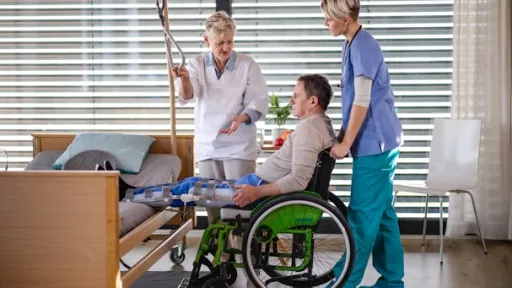
Whether recovery is non-surgical or postoperative, long-term management should rebuild capacity rather than create fear of movement. Walking, graded trunk and hip strengthening, sensible lifting technique and progressive return to work are more useful than indefinite avoidance. After surgery, restrictions depend on the procedure; a simple microdiscectomy and a fusion have very different rehabilitation timelines.

When another diagnosis should be reconsidered

If leg pain persists despite treatment and imaging does not convincingly explain the symptoms, clinicians should reconsider hip pathology, peripheral neuropathy, entrapment neuropathy, vascular claudication and other causes. Repeating spine procedures for a non-spinal pain generator is unlikely to help. Diagnostic humility is especially important when symptoms are atypical or bilateral.

What counts as a fair trial of conservative care?

A fair trial is more than taking pain tablets intermittently. It usually includes maintaining activity, a structured exercise programme, appropriate medication when safe, and enough follow-up to confirm whether function is improving. In selected patients an injection may form part of that trial. If the treatment has been inconsistent or limited to passive modalities, the next step may be a more coherent rehabilitation plan rather than immediate surgery.

When pain itself becomes a legitimate surgical reason

Neurological deficit is not required for every discectomy. A patient with severe, persistent radicular pain that clearly matches a compressed nerve may reasonably choose surgery after informed discussion when sleep, walking or work remain substantially impaired despite appropriate care. The decision is elective, but that does not make the suffering trivial. The key is diagnostic concordance and informed preference.

Why postoperative rehabilitation still matters after a small operation

A technically successful discectomy can relieve the compressed nerve, but weeks of guarding and reduced activity may have left the patient deconditioned. Gradual walking, trunk and hip strengthening, movement confidence and return to normal lifting help restore function. Recovery should not be framed as protecting a fragile spine indefinitely.

Why patient preference matters once both options are reasonable

When neurological function is stable and both continued conservative care and surgery are medically acceptable, personal priorities matter. A patient with flexible work and steadily improving pain may prefer more time. Another with persistent severe sciatica who cannot sit, drive or sleep may choose decompression sooner. Shared decision-making is appropriate precisely because the clinical situation allows more than one defensible path.

Common Patient Questions

Can physiotherapy make a slipped disc worse?

Appropriately selected exercise is generally safe, but exercises should be modified if they cause progressive neurological symptoms or marked radicular worsening.

Will an injection cure the disc?

No. An injection may reduce inflammation and pain around the nerve, potentially allowing recovery and rehabilitation, but it does not physically remove the herniation.

How quickly does leg pain improve after microdiscectomy?

Many patients notice early improvement, but the course varies. Numbness and weakness can take longer to recover.

Can I avoid surgery if pain is severe?

Sometimes, if neurological function is stable and pain can be managed. Persistent disabling pain despite adequate care can make surgery reasonable even without major weakness.

Does a large herniation always need surgery?

No. Large herniations can regress. The neurological examination and symptom course determine urgency.

Will fusion reduce the chance of recurrence?

Fusion changes the operated segment and is not routinely justified simply to prevent recurrence after a first uncomplicated disc herniation.

Section Content

For patients in Noida and the wider region

For patients in Noida/NCR, a focused spine consultation should establish whether pain is truly radicular and whether the MRI finding matches the examination. Patients from UP, MP or Bihar should bring prior MRI images, records of injections or physiotherapy, and a short note of any change in strength or walking. This helps avoid repeating conservative treatment that has already been appropriately tried.

Editorial medical references

  • AANS: Herniated Disc
  • AANS: Minimally Invasive Spine Surgery

A common misconception

Prolonged bed rest is not the right treatment for a slipped disc. Structured graded activity, guided by pain and neurological status, is usually more effective and reduces stiffness and deconditioning.

Do not find what you're looking for?

Our specialists are here to help. Get expert answers tailored to your condition—no waiting, no guesswork