

When Does a Slipped Disc Need Surgery?

Quick answer

Most slipped discs do not need surgery. Surgery is usually considered when there is progressive neurological weakness, disabling leg pain that persists despite an adequate trial of appropriate non-surgical care, or emergency features such as loss of bladder or bowel control or saddle-area numbness. The decision depends on symptoms, examination and imaging together, not on the MRI alone.

Show More

Most disc prolapses do not go straight to the operating room

A “slipped disc” is usually a disc herniation: part of the disc material protrudes and irritates or compresses a spinal nerve. In the lower back this commonly causes sciatica; in the neck it can cause arm pain and numbness. Many patients improve over days to weeks as inflammation settles and the herniated fragment may reduce in size. The MRI appearance alone should not determine surgery.

Clear reasons for urgent surgical assessment

  • New loss of bladder or bowel control, urinary retention, or numbness in the saddle/perineal region, which may indicate cauda equina compression.
  • Progressive motor weakness such as worsening foot drop or increasing loss of hand/arm power.
  • Severe neurological deficit associated with a large compressive disc where delay could reduce the chance of recovery.
  • Rare situations involving infection, tumour, trauma or another diagnosis rather than a routine degenerative disc.

When surgery is considered but is not an emergency

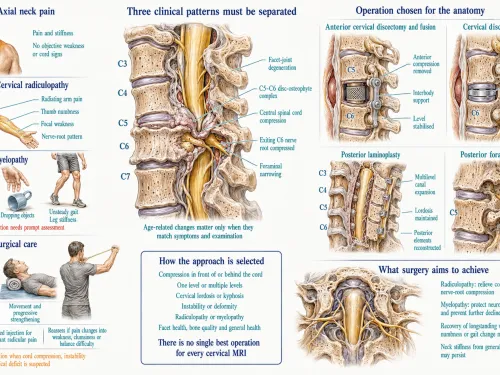
Persistent radicular pain can become a reasonable surgical indication when the pain remains function-limiting despite an adequate trial of medication, activity modification and physiotherapy, and when MRI shows nerve compression that matches the clinical pattern. The important phrase is “matches the clinical pattern.” A disc bulge at the wrong level does not explain symptoms simply because it appears on a scan.

What non-surgical treatment usually includes

  • Keeping active within tolerance rather than prolonged bed rest.
  • Short-term pain and anti-inflammatory medication when medically appropriate.
  • Physiotherapy focused on movement, graded strengthening and return to function.
  • Adjustment of lifting, sitting and work activity during the acute phase.
  • Selected spinal injections when the diagnosis is clear and pain is limiting rehabilitation.

What operation is usually performed?

For a lumbar disc herniation causing sciatica, the common operation is a discectomy or microdiscectomy, often with a limited laminotomy to reach and decompress the affected nerve. The goal is to remove the fragment compressing the nerve, not to remove the entire disc. Fusion is not routinely required for every simple disc herniation. It is considered only when there is a separate reason such as instability, deformity, recurrent disease in selected cases or another structural problem.

Why timing matters when weakness is present

Pain can often be observed safely for a period if the patient is neurologically stable. Progressive motor weakness is different because prolonged severe nerve compression can reduce the likelihood of full recovery. The degree, duration and rate of progression matter. A mild stable weakness may be handled differently from a rapidly worsening foot drop.

MRI findings that should not be over-treated

Disc degeneration, small bulges and even herniations can be seen in people without symptoms. Surgery should therefore target a concordant lesion: the side, level and nerve root on MRI should make sense with the pain distribution, examination and any weakness or reflex change. Treating an incidental MRI abnormality is a common route to disappointing outcomes.

Pain and weakness should be followed separately

Pain can fluctuate markedly from day to day and can improve even while weakness persists. Motor recovery follows a different biological timeline because a compressed nerve may need weeks or months to regain function. Patients with weakness should therefore have objective power documented and rechecked rather than using pain relief as the only measure of recovery.

What a focused examination looks for

For lumbar disc disease, the clinician checks hip, knee, ankle and toe strength, reflexes, sensory distribution, nerve tension signs and gait. The ability to heel-walk or toe-walk can reveal functional weakness. In cervical disc disease, shoulder, elbow, wrist and hand power are assessed together with reflexes and any signs of spinal cord involvement. This examination helps determine whether the MRI finding is clinically important.

What surgery is likely to improve first

When a compressed nerve is accurately identified, radiating leg or arm pain often improves earlier than numbness or weakness. Sensory symptoms can fade gradually, and longstanding numbness may not recover completely. Back pain from generalized degeneration may remain even after successful discectomy. Setting these expectations before surgery reduces the common misconception that removal of one disc fragment will make the entire spine symptom-free.

Recurrent disc herniation does not always require fusion

If symptoms recur after a previous discectomy, a new MRI is needed to distinguish recurrent herniation from scar tissue, stenosis or another level. Repeat decompression may be sufficient in selected cases. Fusion is considered when there is instability, significant mechanical pain or another structural reason, rather than automatically because the disc has herniated twice.

How to recognize a genuine change in motor function

Patients with severe pain may feel weak because movement hurts, but true motor deficit persists even when effort is encouraged. Practical signs include new difficulty heel-walking, repeated tripping, inability to lift the big toe, loss of calf push-off or a hand grip that is objectively weaker than before. If these changes are progressing, waiting for pain to improve is not enough.

What influences nerve recovery after decompression

Recovery depends on how severely the nerve was compressed, how long weakness was present, the patient’s age and health, and whether the nerve has additional injury. Decompression removes the mechanical pressure but does not instantly restore damaged nerve fibres. Rehabilitation is therefore directed at maintaining joint movement, rebuilding strength and preventing compensatory gait problems while the nerve recovers.

When pain control itself becomes unsafe to continue

Some patients can manage severe radicular pain only with escalating sedating medication, repeated emergency visits or prolonged immobility. Even without progressive weakness, this can make continued conservative care impractical. If the diagnosis is clear and a decompression is likely to address the nerve pain, surgery may be discussed because the burden and risks of ongoing symptom control have become significant.

When symptoms are improving, the follow-up visit should confirm that strength is stable as well as asking about pain. A patient who feels less pain but is developing more foot weakness needs a different plan from one whose pain and power are both recovering.

Common Patient Questions

How long should I try non-surgical treatment?

There is no rigid duration for every patient. Many improve within several weeks. The presence of progressive weakness or cauda equina symptoms shortens the safe waiting period.

Will surgery cure all back pain?

Discectomy is mainly aimed at nerve-related leg or arm symptoms. Mechanical back or neck pain may have several contributors and may not disappear completely.

Can a slipped disc recur after surgery?

Yes. Recurrent herniation can occur at the operated level, although many patients recover without recurrence.

Does foot drop always recover after surgery?

Recovery varies with severity, duration, age and cause. Decompression may improve the chance of recovery when compression is responsible, but no operation can guarantee full motor return.

Is bed rest recommended?

Prolonged bed rest is generally not advised for uncomplicated disc herniation. Activity is usually continued within tolerance.

For patients in Noida and the wider region

For patients in Noida, Greater Noida, Ghaziabad and Delhi NCR, the decision for disc surgery should be based on examination and MRI correlation, not on scan wording alone. Patients travelling from UP, MP or Bihar should bring the MRI images and note any objective weakness, bladder symptoms or change in walking because these details influence urgency.

Editorial medical references

  • AANS: Herniated Disc

Do not find what you're looking for?

Our specialists are here to help. Get expert answers tailored to your condition—no waiting, no guesswork