


Slipped Disc vs Sciatica: What Is the Difference?

Quick answer

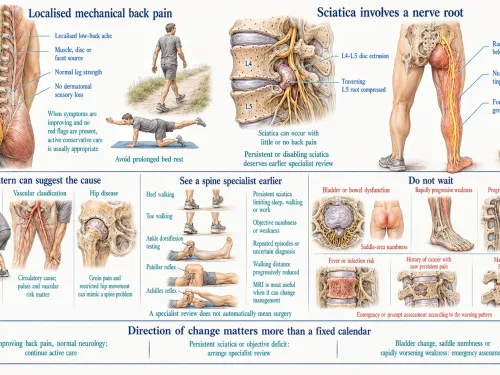
Slipped disc is a diagnosis referring to displacement of intervertebral disc material. Sciatica is a symptom, meaning pain that radiates along the course of the sciatic nerve, usually from the lower back into the buttock and down the leg. A slipped disc is one common cause of sciatica, but sciatica can also arise from other causes such as spinal stenosis, piriformis syndrome or nerve root inflammation.

Show More

One is a diagnosis; the other is a symptom pattern

The terms are often used interchangeably, which creates confusion. A lumbar disc herniation means disc material has protruded beyond its usual boundary. Sciatica describes pain or neurological symptoms travelling from the lower back or buttock into the leg along a nerve-root distribution. The distinction matters because treatment should target the cause of the nerve irritation rather than the word used by the patient.

What sciatica usually feels like

Sciatica often produces sharp, electric, burning or shooting pain that travels from the buttock down the thigh and sometimes into the calf or foot. Numbness or tingling may accompany the pain. When motor fibres are affected, a patient may notice difficulty lifting the ankle or big toe, pushing off the foot, climbing stairs or standing on the toes. Leg pain may be more prominent than back pain.

Why a disc can be present without symptoms

Disc degeneration and bulges are common on MRI, including in people who have no pain. A herniation becomes clinically meaningful when its location corresponds to the symptomatic nerve and the examination supports that relationship. This is why treating the scan rather than the patient can lead to unnecessary procedures.

Other causes of sciatica-like symptoms

  • Lumbar spinal stenosis narrowing the space available for nerve roots.
  • Spondylolisthesis, where one vertebra slips relative to another and narrows a nerve exit zone.
  • Facet or bony overgrowth causing foraminal narrowing.
  • Less commonly, infection, tumour, fracture or inflammatory disease affecting the nerve pathway.
  • Peripheral nerve disorders, hip disease and vascular problems that can mimic radicular pain.

How doctors decide whether imaging is needed

In a typical short-duration episode without major weakness or red flags, initial management may be clinical. MRI becomes more relevant when symptoms persist, surgery or injection is being considered, or there is significant neurological deficit. Urgent imaging is required when there is progressive weakness, saddle numbness, bladder or bowel dysfunction, or suspicion of infection, tumour or major trauma.

Treatment depends on the cause and trajectory

Uncomplicated sciatica from a disc herniation often improves with time, activity within tolerance, appropriate medication and physiotherapy. Surgery is considered when there is progressive neurological loss or persistent disabling radicular pain with concordant compression. Sciatica from stenosis or instability may require a different operation, and pain caused by a peripheral nerve or hip problem will not improve by treating the lumbar disc.

The distribution can suggest which nerve is involved

Pain into the front of the thigh, outer calf, dorsum of the foot or sole can suggest different nerve roots, but real patients do not always follow textbook maps. Motor findings can be more useful: weakness lifting the ankle, extending the big toe or pushing down through the forefoot points toward different root patterns. Reflex changes add another piece of evidence. The diagnosis is built from the combination rather than one pain drawing.

Not all leg pain from the back is sciatica

Referred pain from facet joints, sacroiliac structures or muscles can extend into the buttock or thigh without true nerve-root compression. This pain is often more diffuse and does not produce objective weakness, dermatomal sensory loss or reflex change. Treatment may focus on movement, conditioning and the mechanical source rather than nerve decompression.

Common mimics outside the spine

Hip arthritis can produce groin and thigh pain, peroneal nerve compression can cause foot weakness or numbness, and peripheral neuropathy can cause bilateral burning or tingling in the feet. Vascular disease can cause exertional calf pain. A patient with an abnormal lumbar MRI can still have one of these conditions, so the presence of spinal degeneration should not end the diagnostic process.

Why the distinction changes the treatment

If the problem is true radiculopathy from a disc, anti-inflammatory treatment, nerve-directed rehabilitation, injection or discectomy may be relevant. If pain is referred but no nerve is compressed, a nerve-root procedure is unlikely to help. If the cause is outside the spine, treatment needs to be redirected altogether. Accurate labelling therefore prevents unnecessary interventions.

Sciatica can change sides or levels over time

A patient who had right-sided sciatica years ago can later develop a left-sided episode from a different disc or level. Old MRI findings should not automatically be reused to explain new symptoms. When the neurological pattern has changed significantly, a fresh clinical assessment is needed and new imaging may be appropriate if intervention is being considered.

Bilateral symptoms deserve a broader view

Pain or numbness in both legs may occur with central spinal stenosis, a large midline disc, peripheral neuropathy or vascular disease. Bilateral symptoms accompanied by saddle numbness or bladder dysfunction are particularly concerning for cauda equina compression and need urgent assessment. The pattern is more important than the word “sciatica.”

The word “sciatica” should not replace a neurological examination

Two people can both describe “sciatica” yet have different nerve roots, different causes and different urgency. Examination of power, reflexes, sensation and gait turns the symptom label into a working diagnosis. That step is especially important before an injection or operation, because those treatments must be directed to the correct level and side.

The same principle applies after treatment: improvement in radiating pain supports the nerve diagnosis, while persistent atypical pain should prompt reconsideration rather than repeated treatment at the same spinal level without new evidence.

Common Patient Questions

Can sciatica occur without back pain?

Yes. Some patients have prominent leg pain with little or no back pain.

Can a slipped disc cause only back pain?

Yes. A disc may cause axial back pain without sciatica, although back pain also has many other causes.

Does tingling mean permanent nerve damage?

Not necessarily. Tingling indicates nerve irritation but does not by itself establish permanent injury. Progressive weakness is more concerning.

Is an MRI always needed for sciatica?

No. It is most useful when symptoms persist, neurological deficits are present, or an invasive treatment is being considered.

Can sciatica recover without surgery?

Yes. Many episodes improve with non-surgical treatment, especially when motor function is stable.

For patients in Noida and the wider region

For patients in Noida, Greater Noida, Ghaziabad and Delhi NCR, a clinical examination can often distinguish true radiculopathy from common mimics before deciding on MRI or intervention. Patients from UP, MP or Bihar who already have imaging should bring the actual images so that the symptomatic side and nerve level can be matched to the scan.

Editorial medical references

  • AANS: Herniated Disc

A common misconception

Sciatica is not a specific disease. Calling leg pain simply sciatica without identifying the underlying cause can delay recognition of the actual source, which changes what treatment will help.

Do not find what you're looking for?

Our specialists are here to help. Get expert answers tailored to your condition—no waiting, no guesswork