



Brain Aneurysm Coiling vs Clipping: How Treatment Is Selected

Quick answer

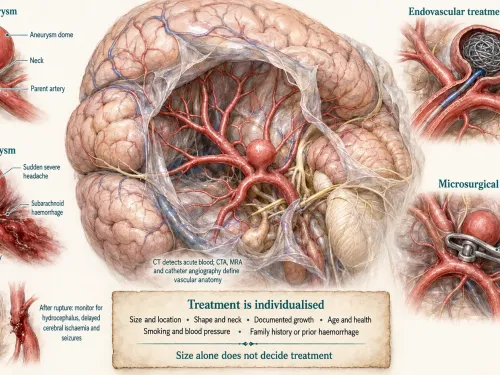
Coiling and clipping are both established treatments for brain aneurysms. Clipping is a microsurgical operation that places a small clip across the neck of the aneurysm from the outside. Coiling is an endovascular procedure performed through a blood vessel from the groin or wrist, in which soft platinum coils fill the aneurysm from inside. The choice depends on aneurysm shape, size, neck, location, patient age and general condition.

Show More

There is no universal winner

Patients often ask which method is “better.” That question cannot be answered without seeing the angiography. A narrow-neck aneurysm in one location may be straightforward to coil. Another aneurysm may incorporate an important branch and be more suitable for clipping. A wide-neck aneurysm may require a stent or flow-diverting device, which changes the antiplatelet requirements. A ruptured aneurysm adds another set of priorities. Technique follows anatomy.

How coiling works

A microcatheter is navigated from a peripheral artery into the brain circulation and then into the aneurysm. Soft coils are deployed to slow blood flow and promote thrombosis inside the sac. Balloon or stent assistance may be used for selected wide-neck aneurysms. Flow diversion redirects blood along the parent vessel and is particularly useful for certain complex, large, fusiform or recurrent aneurysms, but it usually requires antiplatelet treatment.

How clipping works

Through a craniotomy, the neurosurgeon reaches the aneurysm under magnification, identifies the parent artery and branches, and places a clip across the neck. The objective is to exclude the aneurysm while maintaining normal blood flow. Direct vision can be an advantage when anatomy is complex or when the surgeon also needs to evacuate a clot, decompress the brain or address another surgical issue.

Factors that may favour an endovascular route

  • An aneurysm shape and neck that can be treated securely with coils or an appropriate device.
  • Locations where open microsurgical access would require greater tissue manipulation.
  • Older or medically fragile patients in whom avoiding a craniotomy may reduce physiological stress.
  • Certain posterior-circulation aneurysms that are difficult to reach surgically.
  • Clinical situations where rapid endovascular securing of a ruptured aneurysm is feasible.

Factors that may favour clipping

  • Anatomy in which a clip can reconstruct the neck while preserving incorporated branches.
  • Aneurysms with a large associated intracerebral clot that also requires evacuation.
  • Younger patients in selected cases where long-term durability is a major consideration.
  • Aneurysms that have recanalized after prior endovascular treatment and are surgically accessible.
  • Situations where stent-related antiplatelet therapy is undesirable and a surgical solution is suitable.

Ruptured aneurysms require a different discussion

After subarachnoid haemorrhage, the immediate goal is to secure the aneurysm and prevent rebleeding while managing the patient’s neurological and systemic condition. Treatment choice may be influenced by the amount and location of blood, hydrocephalus, need for clot evacuation, aneurysm anatomy and the patient’s clinical grade. Some adjunctive endovascular devices are less attractive in acute rupture because they require dual antiplatelet therapy, although specialist strategies continue to evolve.

What about recurrence and follow-up?

Endovascularly treated aneurysms are commonly followed with vascular imaging because coils can compact or the aneurysm can recanalize in some cases. Clipped aneurysms can also require follow-up when occlusion is uncertain, the aneurysm was complex or additional aneurysms exist. Follow-up should therefore be based on the individual treatment result rather than a belief that one technique never needs surveillance.

How a multidisciplinary recommendation should sound

A useful recommendation should explain why the aneurysm anatomy fits one option, what the alternative would involve and what trade-offs matter to the patient. A statement such as “we always coil” or “we always clip” is less informative than a case-specific discussion of branch vessels, neck width, aneurysm projection, rupture status, antiplatelet needs and expected durability.

The anatomy that matters on angiography

Treatment planning looks at more than aneurysm diameter. Neck width, dome-to-neck relationship, branch arteries arising from the sac, vessel tortuosity, calcification, thrombus and the angle of access can all determine feasibility. In clipping, the surgeon also considers the working corridor, perforating vessels and whether temporary control of the parent artery is possible. These details explain why two aneurysms of the same measured size can receive different recommendations.

Risks shared by both techniques

Both clipping and endovascular treatment can cause stroke if a normal artery or perforator is compromised. The aneurysm can rupture during either procedure. Anaesthesia, contrast exposure, access-site problems and medical complications also need consideration. The absolute risk varies widely with rupture status, aneurysm complexity and patient health, so published averages should not be substituted for a case-specific estimate.

Stents and flow diversion change the medication discussion

When a stent or flow diverter is implanted, platelet-inhibiting medication is usually required to prevent device thrombosis. That is an important trade-off in patients with recent haemorrhage, another planned operation, bleeding tendency or difficulty taking medication reliably. Device-based treatment can be very effective in selected anatomy, but the medication commitment forms part of the procedure, not an afterthought.

Age alone should not dictate the technique

Older age can make a less invasive route attractive, but anatomy and physiological reserve matter more than a birthday. Likewise, younger age can make long-term durability particularly relevant without automatically favouring surgery. A fit older patient with surgically favourable anatomy and a medically frail younger patient can invert simplistic age-based assumptions.

Previously treated aneurysms require individualized salvage planning

A residual or recurrent aneurysm after coiling may be retreated with additional coils, a stent, flow diversion or clipping depending on the shape of the recurrence. Residual filling after clipping may also be managed endovascularly in selected cases. Prior treatment changes the anatomy and risk, which is why the original procedural records and angiograms are important.

The patient’s preference belongs in the final decision

Once clinicians explain that more than one option is technically reasonable, the patient may value durability, avoidance of craniotomy, medication burden, expected recovery or the likelihood of future imaging differently. Shared decision-making is particularly important for stable unruptured aneurysms, where there is time to weigh these preferences carefully.

Durability should be discussed in the context of retreatment

An endovascular procedure that needs later surveillance or retreatment can still be the appropriate initial choice if it lowers immediate risk. Conversely, the durability of clipping may justify a larger initial operation in selected anatomy. The meaningful comparison is lifetime treatment burden, not simply the number of days in hospital after the first procedure.

Cognitive and functional recovery after rupture can overshadow the access method

In a ruptured aneurysm, neurological outcome is often determined more by the initial haemorrhage and subsequent complications than by whether the aneurysm was clipped or coiled. A patient may have a technically successful procedure yet need prolonged rehabilitation for cognitive, language or motor deficits. Families should therefore avoid equating “minimally invasive” with “minor illness.”

Why angiography review should be multidisciplinary when options are close

When an aneurysm is suitable for more than one method, a joint review can expose trade-offs that are easy to miss from a single procedural perspective. The discussion may include branch preservation, feasibility of complete occlusion, access tortuosity, need for antiplatelet medication, surgical corridor and expected surveillance. The purpose is not to create indecision, but to make the rationale transparent.

What patients should ask about the actual endpoint of treatment

For either method, ask whether the aneurysm is expected to be completely excluded immediately, whether a neck remnant may remain, and what follow-up imaging will be required. With flow diversion, occlusion can develop over time rather than at the moment of treatment. With clipping, intraoperative assessment may confirm branch preservation and exclusion, but complex anatomy can still leave a deliberate remnant. Understanding the endpoint prevents confusion when the first follow-up scan is reviewed.

Patients should also ask what retreatment options remain if the aneurysm later shows residual filling. A good initial strategy preserves future options whenever possible, especially in younger patients with a long surveillance horizon.

Common Patient Questions

Is coiling safer because there is no craniotomy?

It is less invasive, but it still carries risks including stroke, aneurysm rupture and access-related complications. Safety depends on the aneurysm and patient.

Can a coiled aneurysm come back?

Some aneurysms can recanalize or show coil compaction, which is why follow-up imaging is important.

Can a clipped aneurysm recur?

Complete clipping is often durable, but recurrence or residual filling can occur. Follow-up is individualized.

What is a flow diverter?

It is a stent-like device placed in the parent artery to redirect flow away from the aneurysm, used for selected aneurysm types.

Can a previously coiled aneurysm later be clipped?

Yes, in selected recurrences or residual aneurysms, although prior coils can make surgery more complex.

Who should decide between the two methods?

Ideally the case is reviewed by clinicians who understand both endovascular and microsurgical options, with the final recommendation discussed with the patient and family.

For patients in Noida and the wider region

For patients in Noida and Delhi NCR, aneurysm planning is most useful when the CTA/MRA and catheter angiography are reviewed together rather than relying only on a report. Patients travelling from UP, MP or Bihar should bring all prior vascular imaging, especially if the aneurysm has already been coiled, clipped or shown to grow on surveillance.

Editorial medical references

  • AANS: Cerebral Aneurysm
  • NINDS: Cerebral Aneurysms

A common misconception

Coiling is not always safer than clipping, and clipping is not automatically more definitive. Both are effective when applied to appropriate anatomy, and the correct question is which one fits this aneurysm.

Do not find what you're looking for?

Our specialists are here to help. Get expert answers tailored to your condition—no waiting, no guesswork