







Clinical Overview
Headache is one of the most prevalent neurological symptoms and can arise from a wide spectrum of causes ranging from benign tension-type headache to life-threatening intracranial pathology. Following head trauma, post-traumatic headache is defined as a headache developing within 7 days of injury and is a recognized diagnostic entity in the International Classification of Headache Disorders, 3rd edition (ICHD-3).
Headache Classification Committee of the International Headache Society (IHS). ICHD-3. Cephalalgia. 2018;38(1):1–211. doi:10.1177/0333102417738202
McCrory P, et al. Consensus statement on concussion in sport — 5th Berlin conference 2016. Br J Sports Med. 2017;51(11):838–847. doi:10.1136/bjsports-2017-097699 — Headache is the most commonly reported post-concussion symptom.
Common Causes
- Post-traumatic headache (concussion)
- Intracranial hemorrhage
- Skull fracture
- Migraine
- Tension-type headache
- Cervicogenic headache (neck-related)
- Medication overuse headache
The Thunderclap Headache
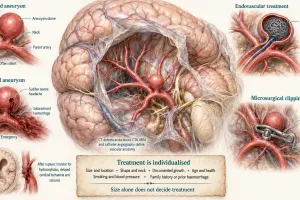
A sudden-onset, severe headache reaching maximal intensity within seconds to minutes ("worst headache of life") is a neurological emergency until proven otherwise. This pattern raises immediate suspicion of subarachnoid hemorrhage (SAH) and requires urgent CT Head followed by lumbar puncture if CT is negative.
Investigations
- CT Head (first-line in acute severe headache)
- MRI Brain (for subacute and chronic presentations)
- Lumbar puncture (when SAH suspected and CT is normal)
- Neurological examination
- Blood tests
|
🔴 RED FLAGS — Seek Emergency Care Immediately • "Thunderclap" headache — sudden severe onset • Headache with fever and neck stiffness • Headache after head trauma • Headache with new neurological deficit • Worsening headache over days/weeks • Headache waking patient from sleep • Vomiting with headache • Seizures |