
Mon–Sat, 8 AM To 10 PM

Top Articles
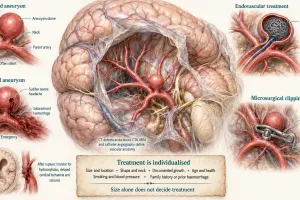
The Evidence Based, universally recognized standard of care treatments for Brain Aneurysm - Sushrut Brain and Spine
A brain or a cerebral aneurysm is a bulging in the...
Read more...


Join our Whatsapp Community
Stay connected with daily health tips, updates, and expert guidance.
Join Now
Sudden Facial Weakness or Paralysis
What is Sudden Facial Weakness?
Sudden facial weakness occurs when the muscles on one side of the face lose strength or become paralyzed. Patients may notice difficulty smiling, speaking, blinking, or making facial expressions.
This symptom is commonly associated with Bell's Palsy but can also indicate more serious neurological conditions such as stroke.
Common Causes
- Bell's Palsy
- Stroke
- Facial nerve inflammation
- Viral infections
- Head trauma
- Brain tumors
- Neurological disorders
How is it Diagnosed?
Doctors assess:
- Facial symmetry
- Forehead movement
- Eye closure
- Speech
- Limb weakness
- Neurological status
Investigations
- Clinical examination
- MRI Brain
- CT Brain
- Nerve conduction studies
- Blood tests
Treatment Options
- Corticosteroids
- Antiviral medications
- Facial physiotherapy
- Eye protection
- Stroke treatment when indicated
When Should You Consult a Doctor?
Immediately after symptom onset.
Red Flags
- Arm or leg weakness
- Speech difficulty
- Vision changes
- Severe headache
- Loss of consciousness
FAQs
Is facial weakness always Bell's Palsy?
No. Stroke must always be excluded.
Can Bell's Palsy recover completely?
Most patients experience significant recovery.
Is treatment more effective if started early?
Yes. Early treatment improves outcomes.
Convulsions
What are Convulsions?
Convulsions are sudden involuntary muscle contractions caused by abnormal electrical activity in the brain. They may involve jerking movements, loss of awareness, or temporary loss of consciousness.
Common Causes
- Head injury
- Epilepsy
- Brain infection
- Stroke
- Brain tumors
- High fever
- Metabolic disturbances
How is it Diagnosed?
Assessment includes:
- Medical history
- Witness accounts
- Neurological examination
Investigations
- EEG
- MRI Brain
- CT Brain
- Blood tests
Treatment Options
- Anti-seizure medications
- Treatment of underlying cause
- Emergency management for prolonged episodes
When Should You Consult a Doctor?
All first-time convulsions require medical evaluation.
Red Flags
- Convulsion lasting >5 minutes
- Repeated episodes
- Injury during episode
- Breathing difficulty
FAQs
Are convulsions the same as seizures?
Convulsions are a type of seizure involving muscle jerking.
Can head injury trigger convulsions?
Yes. Brain trauma is a recognized cause.
Is treatment always required?
Treatment depends on the cause and recurrence risk.
When to Consult:
Prompt neurological assessment can help identify the cause of convulsions and prevent future episodes.
Keywords
Bruising Under the Eyes (Raccoon Eyes / Periorbital Ecchymosis)
What are Raccoon Eyes?
Raccoon eyes (periorbital ecchymosis) refer to bilateral or unilateral dark bruising around the eyes following head trauma. The characteristic appearance results from blood tracking along fascial planes into the periorbital region, confined by the orbital septum. This clinical sign is most commonly associated with fractures of the anterior cranial fossa.
Importantly, raccoon eyes may not appear immediately — they typically develop 1–3 days after initial injury as blood continues to track along tissue planes. The presence of raccoon eyes, when bilateral and not caused by direct periorbital trauma, has strong predictive value for an underlying basilar skull fracture.
| Scientific Accuracy Note: Raccoon eyes are present in 50–60% of basilar skull fractures and are most reliably associated with anterior skull base fractures, particularly involving the frontal and orbital bones. |
PRIMARY: Herbella FA, et al. 'Raccoon eyes' (periorbital haematoma) as a sign of skull base fracture. Injury. 2001;32(10):745–747. [PMID: 11754879]
SUPPORTING: Simon LV, Newton EJ. Basilar Skull Fractures. StatPearls [Updated Aug 2023]. PMID: 29489178
SUPPORTING: McPheeters RA, White S, Winter A. Raccoon eyes. West J Emerg Med. 2010;11(1):97. [PMC2850869]
SUPPORTING: Solai CA, et al. Clinical Signs of Basilar Skull Fracture and Their Predictive Value. J Trauma Nurs. 2018;25(5):301–306. [PMID: 30216260]
Common Causes
- Basilar skull fracture (anterior cranial fossa)
- Facial fractures with periorbital involvement
- Severe blunt head trauma
- Road traffic accidents
- Falls from height
- Sports injuries
Investigations
- CT Head (investigation of choice in acute settings)
- CT Facial Bones (if facial fracture suspected)
- MRI Brain (selected cases for soft-tissue detail)
- Neurological examination
- Skull base assessment
Plain skull X-rays are not sensitive for detecting basilar skull fractures. Multi-detector CT (MDCT) with thin-slice scanning is recommended when basilar fracture is clinically suspected.
Simon LV, Newton EJ. Basilar Skull Fractures. StatPearls [Updated Aug 2023]. PMID: 29489178
|
🔴 RED FLAGS — Seek Emergency Care Immediately • Loss of consciousness • Clear fluid (CSF) leakage from nose or ears • Seizures • Unequal pupils • Limb weakness • Severe worsening headache • Progressive drowsiness |
Bruising Behind the Ears (Battle's Sign / Mastoid Ecchymosis)
What is Battle's Sign?
Battle's Sign refers to bruising over the mastoid process (the bony prominence behind the ear), typically developing 24–72 hours after a significant head injury. It results from blood tracking into the mastoid region along the posterior auricular vessels, and is a classic indicator of a middle cranial fossa basilar skull fracture.
The predictive value of Battle's Sign is clinically significant: studies demonstrate that its presence carries a greater than 75% probability of an underlying basilar skull fracture, a 66% probability of an associated brain lesion, and in some series, a near 100% correlation with skull base fracture.
| Evidence-Based Statistic: Battle's Sign predicts basilar skull fracture with >75% probability. Studies show a 66% chance of brain lesion and near-100% association with skull base fracture when present. |
PRIMARY: Simon LV, Newton EJ. Basilar Skull Fractures. StatPearls [Updated Aug 2023]. PMID: 29489178
SUPPORTING: Solai CA, et al. Clinical Signs of Basilar Skull Fracture and Their Predictive Value in Diagnosis of This Injury. J Trauma Nurs. 2018;25(5):301–306. [PMID: 30216260]
SUPPORTING: Murthy TM, et al. Battle's sign — a clinical sign of basilar skull fracture. J Clin Diagn Res. 2017;11(4):TD01–TD02. doi:10.7860/JCDR/2017/26282.9617
Common Causes
- Basilar skull fracture (middle cranial fossa)
- Severe head injury
- Road traffic accidents
- Falls from height
- Sports injuries
- Assault-related trauma
Investigations
- CT Head (preferred initial imaging)
- CT Skull Base
- MRI Brain (for soft tissue and nerve assessment)
- Neurological examination
- Hearing assessment (audiometry)
|
🔴 RED FLAGS — Seek Emergency Care Immediately • Loss of consciousness • Clear fluid from ears or nose (CSF leak) • Seizures • Severe or worsening headache • Repeated vomiting • Limb weakness • Confusion or agitation • Progressive drowsiness |
Stroke Symptoms
What is a Stroke?
A stroke (cerebrovascular accident) occurs when blood flow to a region of the brain is suddenly interrupted, either by arterial occlusion (ischemic stroke — approximately 85% of cases) or by rupture of a blood vessel (hemorrhagic stroke — approximately 15% of cases). Deprivation of oxygen and glucose leads to neuronal death; it is estimated that approximately 1.9 million neurons die per minute during an untreated ischemic stroke.
"Time is brain" — early reperfusion therapy with intravenous thrombolysis (tPA) within 4.5 hours and mechanical thrombectomy within 24 hours in selected patients significantly improves functional outcomes.
Powers WJ, et al. 2019 AHA/ASA Guidelines for the Early Management of Patients with Acute Ischemic Stroke. Stroke. 2019;50(12):e344–e418. doi:10.1161/STR.0000000000000211
The BE-FAST Acronym (Updated from FAST)
Recent evidence supports the expanded BE-FAST acronym to identify additional stroke symptoms often missed by FAST alone:
- B — Balance: sudden difficulty with balance or coordination
- E — Eyes: sudden vision change, double vision, or loss of vision
- F — Face: facial drooping (ask patient to smile)
- A — Arms: arm or leg weakness (ask patient to raise both arms)
- S — Speech: slurred, confused, or no speech
- T — Time: time to call emergency services immediately
Transient Ischemic Attack (TIA)
Stroke symptoms that resolve completely within 24 hours (and typically within 1 hour) may represent a Transient Ischemic Attack (TIA). TIA is NOT benign — it carries a high short-term risk of completed stroke (up to 10–15% within 90 days, with highest risk in the first 48 hours). All TIA patients require urgent evaluation and secondary prevention.
Johnston SC, et al. Transient ischemic attack: part 1. Diagnosis and evaluation. N Engl J Med. 2002;347(21):1714–1721. doi:10.1056/NEJMcp020190
Treatment
- IV alteplase (tPA): eligible patients within 4.5 hours of symptom onset
- Mechanical thrombectomy: eligible patients within 6–24 hours depending on imaging criteria
- Blood pressure management per guidelines
- Antiplatelet therapy (aspirin / dual antiplatelet in TIA)
- Anticoagulation (in cardioembolic stroke/AF)
- Stroke unit admission
- Rehabilitation: physiotherapy, speech therapy, occupational therapy
|
🔴 RED FLAGS — Seek Emergency Care Immediately • Any sudden onset of BE-FAST symptoms — call emergency services immediately • Sudden severe headache (thunderclap) — may indicate subarachnoid hemorrhage • Sudden loss of vision in one eye (amaurosis fugax) • Stroke symptoms that resolve — still requires emergency evaluation (TIA risk) |
Vertigo
What is Vertigo?
Vertigo is the illusion of movement — specifically a spinning or rotational sensation either of the patient or their surroundings — in the absence of actual movement. It is distinct from dizziness (lightheadedness or pre-syncope) and must be differentiated clinically. Vertigo arises from asymmetric vestibular input reaching the brain.
Vertigo is broadly classified as peripheral (arising from the inner ear or vestibular nerve) or central (arising from the brain — brainstem or cerebellum). Central causes are potentially more serious and require careful clinical differentiation.
Common Causes
- Benign Paroxysmal Positional Vertigo (BPPV) — most common cause of true vertigo
- Vestibular neuritis (acute prolonged vertigo, often post-viral)
- Meniere's disease (recurrent vertigo with hearing loss and tinnitus)
- Migraine-associated vertigo / vestibular migraine
- Posterior fossa stroke or TIA
- Head injury
Bhattacharyya N, et al. Clinical practice guideline: benign paroxysmal positional vertigo. Otolaryngol Head Neck Surg. 2017;156(3_suppl):S1–S47. doi:10.1177/0194599816689667 — BPPV is the most common cause of vertigo; canalith repositioning (Epley maneuver) is effective first-line treatment.
HINTS Examination (to exclude stroke in acute vestibular syndrome)
In patients presenting with continuous acute vertigo, the HINTS (Head Impulse, Nystagmus, Test of Skew) examination is more sensitive than early MRI for detecting posterior fossa stroke:
- Head Impulse: normal (no corrective saccade) → CENTRAL (stroke)
- Nystagmus: direction-changing gaze-evoked nystagmus → CENTRAL
- Test of Skew: vertical skew deviation present → CENTRAL
|
🔴 RED FLAGS — Seek Emergency Care Immediately • Sudden severe vertigo with headache, weakness, or diplopia — posterior fossa stroke • Vertigo with hearing loss and facial weakness • New ataxia or inability to walk • Vertical nystagmus — always indicates central pathology |
Keywords
Migraine
What is Migraine?
Migraine is a primary neurological disorder characterized by recurrent episodes of moderate to severe unilateral (or occasionally bilateral) headache, typically pulsating in quality, lasting 4–72 hours, and associated with nausea, vomiting, photophobia, and phonophobia. It is the second most common cause of disability worldwide.
Approximately 25–30% of migraine patients experience aura — transient, fully reversible neurological symptoms (typically visual, sensory, or speech-related) that precede or accompany the headache phase. In "migraine aura without headache," neurological symptoms occur without the headache phase.
Headache Classification Committee of the International Headache Society. ICHD-3. Cephalalgia. 2018;38(1):1–211. doi:10.1177/0333102417738202 — Authoritative classification and diagnostic criteria for migraine.
Diagnosis
ICHD-3 criteria for migraine without aura require: ≥5 attacks lasting 4–72 hours with at least 2 of the following headache features (unilateral, pulsating, moderate/severe, worsened by activity) AND at least 1 of: nausea/vomiting, or photophobia and phonophobia.
Treatment
- Acute: triptans (first-line), NSAIDs, antiemetics, CGRP antagonists (gepants)
- Preventive: beta-blockers (propranolol), topiramate, amitriptyline, anti-CGRP monoclonal antibodies (erenumab, fremanezumab)
- Lifestyle: sleep hygiene, hydration, stress management, trigger avoidance
|
🔴 RED FLAGS — Seek Emergency Care Immediately • "First or worst" headache — requires exclusion of SAH • Headache with fever and neck stiffness — meningitis • New aura in patient >50 years — exclude TIA/stroke • Progressive headache — exclude space-occupying lesion • Headache with papilloedema — exclude raised ICP |
Headache
Clinical Overview
Headache is one of the most prevalent neurological symptoms and can arise from a wide spectrum of causes ranging from benign tension-type headache to life-threatening intracranial pathology. Following head trauma, post-traumatic headache is defined as a headache developing within 7 days of injury and is a recognized diagnostic entity in the International Classification of Headache Disorders, 3rd edition (ICHD-3).
Headache Classification Committee of the International Headache Society (IHS). ICHD-3. Cephalalgia. 2018;38(1):1–211. doi:10.1177/0333102417738202
McCrory P, et al. Consensus statement on concussion in sport — 5th Berlin conference 2016. Br J Sports Med. 2017;51(11):838–847. doi:10.1136/bjsports-2017-097699 — Headache is the most commonly reported post-concussion symptom.
Common Causes
- Post-traumatic headache (concussion)
- Intracranial hemorrhage
- Skull fracture
- Migraine
- Tension-type headache
- Cervicogenic headache (neck-related)
- Medication overuse headache
The Thunderclap Headache
A sudden-onset, severe headache reaching maximal intensity within seconds to minutes ("worst headache of life") is a neurological emergency until proven otherwise. This pattern raises immediate suspicion of subarachnoid hemorrhage (SAH) and requires urgent CT Head followed by lumbar puncture if CT is negative.
Investigations
- CT Head (first-line in acute severe headache)
- MRI Brain (for subacute and chronic presentations)
- Lumbar puncture (when SAH suspected and CT is normal)
- Neurological examination
- Blood tests
|
🔴 RED FLAGS — Seek Emergency Care Immediately • "Thunderclap" headache — sudden severe onset • Headache with fever and neck stiffness • Headache after head trauma • Headache with new neurological deficit • Worsening headache over days/weeks • Headache waking patient from sleep • Vomiting with headache • Seizures |
What are some common causes of chronic headaches related to brain or spinal issues?
This could be due to any of the following:
- Migraine — caused by abnormal brain activity affecting nerve signals, chemicals, and blood vessels.
- Cervicogenic headache — triggered by issues in the cervical spine, such as nerve compression or poor posture.
- Tension-type headache — often linked to muscle strain in the neck and upper back due to stress or fatigue.
- Brain tumor or increased intracranial pressure — rare but serious causes that require immediate medical attention.
Login to Comment
 316d1h 18m ago
It can be. Mine turned out to be a herniated disc pressing on a nerve. Started with mild neck pain, ended up with numbness in my arm. Got an MRI, started physio. Don’t wait too long if it spreads or tingles.
313d 49m ago
Most of the time it's just bad posture or stress—especially if you’re at a desk all day. But if it sticks around or gets worse at night, go see a doc. Better safe than sorry.