

Lumbar Puncture — CSF Diagnostic Procedure in Noida
Image

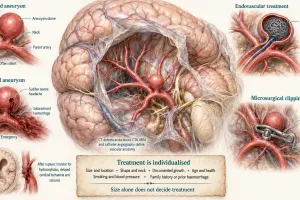
A brain or a cerebral aneurysm is a bulging in the...
Read more...



Stay connected with daily health tips, updates, and expert guidance.
Join Now
Raccoon eyes (periorbital ecchymosis) refer to bilateral or unilateral dark bruising around the eyes following head trauma. The characteristic appearance results from blood tracking along fascial planes into the periorbital region, confined by the orbital septum. This clinical sign is most commonly associated with fractures of the anterior cranial fossa.
Importantly, raccoon eyes may not appear immediately — they typically develop 1–3 days after initial injury as blood continues to track along tissue planes. The presence of raccoon eyes, when bilateral and not caused by direct periorbital trauma, has strong predictive value for an underlying basilar skull fracture.
| Scientific Accuracy Note: Raccoon eyes are present in 50–60% of basilar skull fractures and are most reliably associated with anterior skull base fractures, particularly involving the frontal and orbital bones. |
PRIMARY: Herbella FA, et al. 'Raccoon eyes' (periorbital haematoma) as a sign of skull base fracture. Injury. 2001;32(10):745–747. [PMID: 11754879]
SUPPORTING: Simon LV, Newton EJ. Basilar Skull Fractures. StatPearls [Updated Aug 2023]. PMID: 29489178
SUPPORTING: McPheeters RA, White S, Winter A. Raccoon eyes. West J Emerg Med. 2010;11(1):97. [PMC2850869]
SUPPORTING: Solai CA, et al. Clinical Signs of Basilar Skull Fracture and Their Predictive Value. J Trauma Nurs. 2018;25(5):301–306. [PMID: 30216260]
Plain skull X-rays are not sensitive for detecting basilar skull fractures. Multi-detector CT (MDCT) with thin-slice scanning is recommended when basilar fracture is clinically suspected.
Simon LV, Newton EJ. Basilar Skull Fractures. StatPearls [Updated Aug 2023]. PMID: 29489178
|
🔴 RED FLAGS — Seek Emergency Care Immediately • Loss of consciousness • Clear fluid (CSF) leakage from nose or ears • Seizures • Unequal pupils • Limb weakness • Severe worsening headache • Progressive drowsiness |
Clear fluid draining from the nose (CSF rhinorrhea) or ear canal (CSF otorrhea) following head trauma represents a neurological emergency. This fluid is cerebrospinal fluid (CSF) — the protective fluid circulating in the subarachnoid space around the brain and spinal cord — and its leakage almost always indicates a defect in the dura mater overlying a skull base fracture.
CSF leaks carry a significant risk of ascending bacterial meningitis (predominantly Streptococcus pneumoniae), with estimated meningitis rates of approximately 10–25% in untreated post-traumatic CSF leaks. The risk increases with duration of the leak.
Ziu M, Savage JG, Jimenez DF. Diagnosis and treatment of cerebrospinal fluid rhinorrhea following accidental traumatic anterior skull base fractures. Neurosurg Focus. 2012;32(6):E3. doi:10.3171/2012.4.FOCUS1264 — Key reference for post-traumatic CSF leak management.
Beta-2 transferrin is a protein almost exclusively found in CSF, vitreous humor, and perilymph. Its identification in nasal or aural discharge is the most reliable biochemical confirmation of CSF leakage.
|
🔴 RED FLAGS — Seek Emergency Care Immediately • ANY clear fluid from nose or ear after head trauma — treat as CSF leak until proven otherwise • Fever (may indicate developing meningitis) • Severe headache • Photophobia or neck stiffness • Confusion or deteriorating consciousness • Seizures |