
Mon–Sat, 8 AM To 10 PM

Top Articles
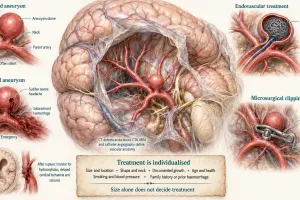
The Evidence Based, universally recognized standard of care treatments for Brain Aneurysm - Sushrut Brain and Spine
A brain or a cerebral aneurysm is a bulging in the...
Read more...



Join our Whatsapp Community
Stay connected with daily health tips, updates, and expert guidance.
Join Now
Vertigo
What is Vertigo?
Vertigo is the illusion of movement — specifically a spinning or rotational sensation either of the patient or their surroundings — in the absence of actual movement. It is distinct from dizziness (lightheadedness or pre-syncope) and must be differentiated clinically. Vertigo arises from asymmetric vestibular input reaching the brain.
Vertigo is broadly classified as peripheral (arising from the inner ear or vestibular nerve) or central (arising from the brain — brainstem or cerebellum). Central causes are potentially more serious and require careful clinical differentiation.
Common Causes
- Benign Paroxysmal Positional Vertigo (BPPV) — most common cause of true vertigo
- Vestibular neuritis (acute prolonged vertigo, often post-viral)
- Meniere's disease (recurrent vertigo with hearing loss and tinnitus)
- Migraine-associated vertigo / vestibular migraine
- Posterior fossa stroke or TIA
- Head injury
Bhattacharyya N, et al. Clinical practice guideline: benign paroxysmal positional vertigo. Otolaryngol Head Neck Surg. 2017;156(3_suppl):S1–S47. doi:10.1177/0194599816689667 — BPPV is the most common cause of vertigo; canalith repositioning (Epley maneuver) is effective first-line treatment.
HINTS Examination (to exclude stroke in acute vestibular syndrome)
In patients presenting with continuous acute vertigo, the HINTS (Head Impulse, Nystagmus, Test of Skew) examination is more sensitive than early MRI for detecting posterior fossa stroke:
- Head Impulse: normal (no corrective saccade) → CENTRAL (stroke)
- Nystagmus: direction-changing gaze-evoked nystagmus → CENTRAL
- Test of Skew: vertical skew deviation present → CENTRAL
|
🔴 RED FLAGS — Seek Emergency Care Immediately • Sudden severe vertigo with headache, weakness, or diplopia — posterior fossa stroke • Vertigo with hearing loss and facial weakness • New ataxia or inability to walk • Vertical nystagmus — always indicates central pathology |
Keywords