



When Should You See a Neurosurgeon for Headache?

Quick answer

Most headaches, including migraine, tension-type and cluster headache, are managed by a neurologist or primary care physician rather than a neurosurgeon. A neurosurgical opinion becomes relevant when imaging reveals a structural lesion such as a tumour, aneurysm, vascular malformation, Chiari malformation, hydrocephalus or a significant post-traumatic finding, or when severe sudden headache raises concern for haemorrhage.

Show More

Image
When Should You See a Neurosurgeon for Headache


A neurosurgeon is not the first stop for most headaches

Migraine, tension-type headache and other primary headache disorders are common and are usually diagnosed from the clinical history and neurological examination. Their treatment is predominantly medical. Seeing a neurosurgeon makes sense when the headache is secondary to a problem that might need surgical or procedural treatment, or when imaging has already shown an abnormality requiring interpretation.

Headache red flags that need urgent medical evaluation

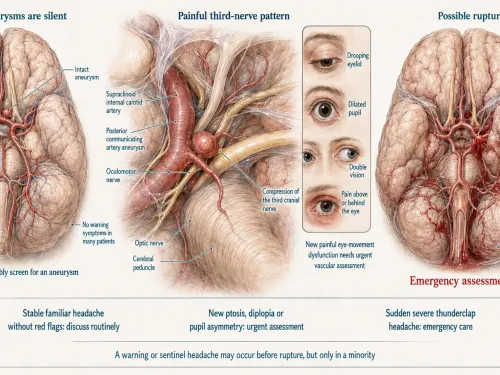
  • A thunderclap headache that reaches maximal intensity very quickly.
  • Headache with new weakness, speech difficulty, double vision, visual loss, confusion or loss of consciousness.
  • Headache with a first seizure.
  • Progressively worsening headache with persistent vomiting or drowsiness.
  • New headache associated with fever, significant systemic illness or immune suppression.
  • New or changed headache after significant head injury.
  • Headache with abnormal neurological examination or optic-nerve swelling.

These symptoms do not automatically mean a surgical disease. They require urgent evaluation because causes can include stroke, haemorrhage, meningitis, venous thrombosis, raised intracranial pressure and other emergencies. The emergency department or neurologist may be the appropriate first point of contact, with neurosurgery involved when imaging identifies a surgical problem.

Situations where neurosurgical review is particularly useful

  • MRI or CT shows a brain tumour, cyst, hydrocephalus or other mass lesion.
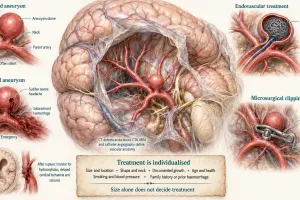
  • An aneurysm or vascular malformation has been identified and surgical or endovascular treatment is being considered.
  • Raised intracranial pressure is suspected because of a structural obstruction or lesion.
  • A subdural collection or other post-traumatic abnormality has been found.
  • Headache is related to a known cranial lesion whose growth or treatment needs reassessment.

When brain imaging is and is not useful

People with stable migraine, a typical history and a normal neurological examination often do not need routine MRI simply because the pain is severe. Imaging becomes more appropriate when the headache is new, changes substantially, has a positional or exertional pattern, begins after age 50, is accompanied by focal neurological signs, or does not fit a recognised primary headache pattern. CT is often used in emergency headache; MRI provides more detailed assessment for many non-emergency structural questions.

If the scan shows an incidental abnormality

Modern imaging frequently reveals findings that are unrelated to the headache. Small cysts, benign-appearing tumours or vascular variants may be incidental. A neurosurgeon can help determine whether the finding plausibly causes the symptoms, whether surveillance is needed and whether treatment would actually improve the headache. Operating on an incidental finding is not appropriate simply because the patient has pain.

Neurology and neurosurgery often work together

A neurologist is usually central to migraine and other primary headache disorders. Neurosurgery becomes relevant for structural conditions. In complex cases the distinction is not always obvious at the first visit, which is why an integrated neuroscience model is useful: the patient can be directed toward the discipline that matches the underlying problem rather than the symptom alone.

When the emergency department is more appropriate than an outpatient clinic

A thunderclap headache, headache with new focal neurological deficit, collapse, meningism or altered consciousness requires acute evaluation. The first task is to exclude haemorrhage, stroke, infection or another emergency. A routine appointment with any specialist, including a neurosurgeon, is the wrong pathway when minutes or hours matter.

When a neurologist is usually the appropriate specialist

Recurrent migraine, chronic daily headache, cluster headache and medication-overuse headache are primarily neurological disorders. Treatment may involve preventive medication, acute therapy, trigger management and attention to sleep and analgesic frequency. Neurosurgery has little role unless imaging identifies a separate structural lesion.

Medication overuse can create a misleading picture

Frequent use of acute headache medication can perpetuate chronic headache in susceptible patients. Someone with increasingly frequent headaches may therefore need a careful medication history before assuming that the change represents a tumour. This does not remove the need to investigate red flags, but it is a common and treatable contributor to headache progression.

What to do with an abnormal scan report before panicking

Terms such as “arachnoid cyst,” “empty sella,” “small meningioma” or nonspecific white-matter changes can sound alarming. Many such findings are incidental. The clinician should determine whether the location and biology plausibly explain the headache. Treating an incidental structural finding solely in the hope of curing a primary headache can expose the patient to unnecessary risk.

Bring the headache story, not only the scan

For a useful consultation, record onset, frequency, duration, location, associated nausea or visual symptoms, triggers, current pain medication and any neurological deficits. The scan answers an anatomical question; the history determines whether that anatomy is clinically relevant.

A neurosurgical consultation should answer whether the lesion explains the headache

When imaging shows a structural abnormality, the key question is causation. Is there mass effect, raised pressure, obstruction of cerebrospinal-fluid flow, haemorrhage or another mechanism that plausibly produces headache? If not, the finding may simply coexist with migraine or tension-type headache. A good neurosurgical opinion can be valuable precisely because it concludes that surgery is unnecessary.

Headache after previous brain surgery needs individualized review

Postoperative headache can arise from healing tissues, scalp nerves, neck muscles, cerebrospinal-fluid pressure changes or the original disease. A new or worsening pattern after surgery should be discussed with the treating team, particularly if accompanied by fever, wound change, vomiting or neurological deficit. Not every postoperative headache indicates recurrence, but the context changes the threshold for reassessment.

When a second opinion can help after imaging

If a scan shows a lesion and surgery has been suggested mainly for headache, another opinion can be useful when the relationship between the lesion and pain is uncertain. The second review should address whether the finding causes mass effect or raised pressure, whether it is growing, and what symptom improvement surgery is realistically expected to provide. The purpose is diagnostic clarity, not delay for its own sake.

For chronic headache, continuity is valuable. A clinician who has seen the patient’s usual pattern can recognise a true departure from baseline more easily than a series of isolated consultations. Keeping previous imaging and a concise headache diary improves that continuity.

Common Patient Questions

Do I need a neurosurgeon for migraine?

Usually not. Migraine is generally managed by neurology unless imaging identifies a separate structural problem.

Should every headache get an MRI?

No. Imaging is selected according to the headache pattern, examination and red flags.

If a brain cyst is found during headache work-up, is surgery needed?

Often not. The neurosurgeon must first determine whether the cyst is clinically relevant.

Can a brain tumour cause a headache with a normal examination?

It can, although most headaches are not due to tumours. Persistent change in pattern may justify imaging even when the examination is initially normal.

Where should I go for a sudden thunderclap headache?

To emergency care immediately, not to a routine outpatient appointment.

For patients in Noida and the wider region

Patients in Noida, Greater Noida, Ghaziabad and Delhi NCR with ordinary recurrent headache can often begin with neurology, while emergency red flags should go directly to acute care. Patients from UP, MP or Bihar with an already identified structural lesion should bring the original scan images for neurosurgical review.

Editorial medical references

  • American Migraine Foundation: Headache, MRI and Brain Imaging
  • American Migraine Foundation: Changes in Headache Symptoms
  • AANS: Brain Tumors

A common misconception

Seeing a neurosurgeon does not mean surgery. It means the case is being assessed by someone qualified to advise whether surgery is appropriate, and often the recommendation is not to operate.

Do not find what you're looking for?

Our specialists are here to help. Get expert answers tailored to your condition—no waiting, no guesswork